A person walking away along a gravel path through alpine foothills near Bad Aibling

Urinary Function

Comprehensive evaluation & treatment for urinary disorders in men

St. George Hospital looks for the cause of frequency, urgency, a weak stream, incomplete emptying and nocturia before treating them: prostate, bladder, inflammation, hormones or nerves. The assessment takes two to three days and ends with a written plan that works with the medication your urologist has prescribed. This page explains what we test, how we treat, and what the trials show.

Is this you?

You know every restroom between home and the office.

The urgency, the weak stream, the feeling you are never quite empty. You were handed a pill that made you dizzy and told the rest is age. Quietly, it has started to shape what you say yes to.

Understanding urinary dysfunction

Why the cause matters more than the symptom

Lower urinary tract symptoms affect a large share of men over 50, and many wait years before asking about them, out of embarrassment or because they were told it is age. The symptoms have several causes that look alike from the outside: benign prostatic enlargement that narrows the urethra, an overactive bladder, chronic pelvic inflammation, a hormonal shift, a neurological cause, or kidneys that make too much urine at night. A pill chosen for one cause does little for another.

St. George Hospital separates them before treating. The assessment measures how the bladder fills and empties, what the prostate looks like, whether there is inflammation or infection, and what the hormone panel shows. The plan is written from those findings, in coordination with the medication your urologist has prescribed. Where the cause is the prostate, the hospital's prostate health assessment runs in the same days; where it is hormonal, the hormone optimization work-up does.

A middle-aged man seen from behind on a lakeside bench at a Bavarian lake
Common symptoms

When to have the symptoms assessed

If any of the following has persisted for more than a few weeks, an assessment can name the cause. Blood in the urine, fever with urinary symptoms or a sudden inability to pass urine need a physician the same day, not an appointment abroad.

  • Frequent urination (more than eight times a day)
  • Urgency, or difficulty delaying urination
  • Nocturia (waking two or more times a night to urinate)
  • Weak or intermittent stream
  • Sensation of incomplete emptying
  • Straining, or a long wait before the stream starts
  • Post-void dribbling
  • Recurrent urinary tract infections
  • Pelvic discomfort or pain during urination
  • Blood in the urine (hematuria)
What we test

The assessment, step by step

The assessment takes two to three days as an outpatient and is scheduled so that the laboratory results are back before the physician writes the plan with you. Our diagnostics page describes the laboratory and imaging capacity behind it.

Laboratory

Urinalysis and culture, PSA panel (total, free, ratio), renal function, inflammatory markers (CRP, IL-6), and a hormone panel with testosterone, DHT, estradiol and cortisol. Infection and inflammation are excluded first, because they change the plan.

Function

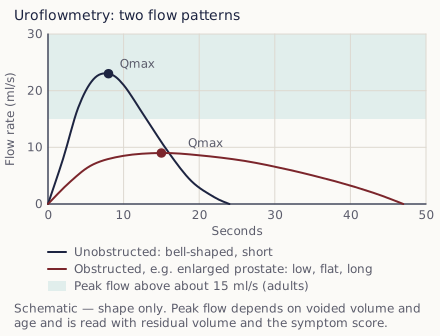
Uroflowmetry for flow rate and pattern, post-void residual volume by ultrasound, a three-day frequency-volume diary, and the International Prostate Symptom Score (IPSS). These are the values the hospital measures again after treatment, and they are what you receive in the report.

Imaging

Transrectal and transabdominal ultrasound for prostate volume, bladder wall thickness and residual urine, and assessment of the upper urinary tract where the findings call for it. Where a neurological cause is suspected, the physician refers for urodynamic testing.

Line chart of urinary flow rate in milliliters per second over time: an unobstructed bell-shaped curve peaking above 15 milliliters per second and finishing in about 25 seconds
Uroflowmetry: two flow patterns. Schematic, not to scale.
How we treat

Treatment follows the finding

When the bladder is the cause

Bladder training, timed voiding, urge-suppression techniques and pelvic floor physiotherapy are taught on the ward, with a diary to continue at home. In the MOTIVE trial, men with overactive bladder symptoms on an alpha-blocker were randomized to this behavioral treatment or to an antimuscarinic drug; both reduced voids per day to the same degree, and the behavioral group had the larger reduction in night-time voids (Burgio et al., J Am Geriatr Soc, 2011). Drug therapy is added where the diary shows it is needed.

When inflammation is the cause

Chronic pelvic inflammation drives frequency, urgency and pain in a subset of men. The plan combines anti-inflammatory infusions, dietary measures, phytotherapy as a supportive measure and, where cultures are positive, targeted antibiotics. The pain and symptom scores are measured at the start and again in week two.

When hormones or the night are the cause

A shifted ratio of estradiol to testosterone or high DHT can drive both prostate growth and bladder irritability; the physician adjusts it with bioidentical and nutritional measures, described under hormone therapy. For nocturia, the diary shows whether the kidneys make too much urine at night; where they do, titrated antidiuretic therapy with blood sodium checks is the measure the European guideline review found effective (Sakalis et al., Eur Urol, 2017).

What the trials show, and what they do not

Medication for prostatic obstruction rests on strong evidence and behavioral treatment for overactive bladder on moderate evidence. Plant extracts have limited evidence and are used as supportive measures, not as treatment for obstruction.

Read the evidence in detail

Evidence is graded on this page in four words: strong, moderate, emerging and limited. Medication for prostatic obstruction: strong (MTOPS, above). Behavioral treatment for overactive bladder in men: moderate (MOTIVE, above). Heat for benign enlargement: moderate for transurethral microwave thermotherapy, the urological procedure; a Cochrane review of 15 trials in 1,585 men found symptom scores fell by about two thirds with it and by about three quarters with transurethral resection (Hoffman et al., Cochrane Database Syst Rev, 2012). This review concerns urological procedures, not a service offered by St. George Hospital.

Phytotherapy: limited. In a one-year randomized trial, saw palmetto did not improve symptoms, flow, prostate size or residual volume compared with placebo (Bent et al., N Engl J Med, 2006), and a later trial of increasing doses of the extract found no benefit over placebo either (Barry et al., JAMA, 2011). The hospital uses plant extracts as supportive measures and does not rely on them to treat obstruction. Nocturia: the European guideline review found that the usual prostate and bladder drugs were generally not better than placebo for night-time voids in the short term, and that antidiuretic therapy needs a sodium check before and during treatment (Sakalis et al., above). What the evidence does not show is that any measure on this page restores a normal stream in a man with a tight obstruction; where the flow and residual volume say surgery, the physicians say so and refer you.


Costs and billing

Treatment at St. George Hospital is self-pay. Costs are individual: a package price plus individual add-ons, set out in a written, itemized cost overview after a physician has read your findings. A deposit is paid before admission. After the stay you receive an itemized invoice in English that you can submit to your insurer; reimbursement is not promised. Details are on costs and insurance.

Traveling here

Patients from more than 60 countries have been treated here. Munich Airport is about 60 minutes by car; the International Office arranges the transfer (charged extra) and the video consultation before you travel, and the assessment can be combined with the prostate and hormone work-ups in the same days. The practical side is under information for international patients.

FAQ

Questions men ask about urinary symptoms

Are urinary symptoms in men always caused by the prostate?

No. An enlarged prostate is the most common cause of a weak stream and incomplete emptying, but urgency and frequency often come from an overactive bladder, nocturia from how much urine the kidneys make at night, and some symptoms from chronic pelvic inflammation or a hormonal shift. The assessment separates these, because each is treated differently.

I was given an alpha-blocker and it made me dizzy. What else is there?

Alpha-blockers and 5-alpha-reductase inhibitors remain the most tested medication for an enlarged prostate, and the MTOPS trial found the combination reduced clinical progression by two thirds. Where you cannot tolerate them, the physician discusses a different drug, bladder training, and local or anti-inflammatory measures, and writes the plan together with your urologist rather than replacing the medication on his own.

Does bladder training work for men?

Yes, in the trial that tested it. In the MOTIVE trial, men with overactive bladder symptoms on an alpha-blocker were randomized to behavioral treatment or an antimuscarinic drug; both reduced voids per day to the same degree, and the behavioral group had the larger reduction in night-time voids. The hospital teaches the method on the ward and gives you the diary to continue at home.

Do saw palmetto and other plant extracts help?

The two largest trials say no. In a one-year randomized trial saw palmetto did not improve symptoms or flow compared with placebo, and in a later trial increasing doses of the extract did no better than placebo. The hospital uses phytotherapy only as a supportive measure and says so; it does not rely on it to treat obstruction.

What can be done about getting up at night?

First, a frequency-volume diary over three days to see whether the kidneys make too much urine at night, the bladder holds too little, or sleep is the problem. The European urology guideline review found that titrated antidiuretic therapy reduces night-time voids, with blood sodium checked before and during treatment, while the usual prostate and bladder drugs were generally not better than placebo for nocturia in the short term.

How much does the assessment cost?

This page lists no prices. After a physician has reviewed your findings, you receive a written, itemized cost overview: a package price plus individual add-ons. Nothing is booked before you have it. Details are on costs and insurance.

If you want the assessment, send a note of your symptoms, any flow or ultrasound reports and your current medication. A physician reads them before the video consultation and tells you in writing what the work-up here would add.

References

  1. The long-term effect of doxazosin, finasteride, and combination therapy on the clinical progression of benign prostatic hyperplasia.. N Engl J Med 2003. PMID 14681504
  2. Behavioral versus drug treatment for overactive bladder in men: the Male Overactive Bladder Treatment in Veterans (MOTIVE) Trial.. J Am Geriatr Soc 2011. PMID 22092152
  3. Saw palmetto for benign prostatic hyperplasia.. N Engl J Med 2006. PMID 16467543
  4. Effect of increasing doses of saw palmetto extract on lower urinary tract symptoms: a randomized trial.. JAMA 2011. PMID 21954478
  5. Medical Treatment of Nocturia in Men with Lower Urinary Tract Symptoms: Systematic Review by the European Association of Urology Guidelines Panel for Male Lower Urinary Tract Symptoms.. Eur Urol 2017. PMID 28666669
  6. Microwave thermotherapy for benign prostatic hyperplasia.. Cochrane Database Syst Rev 2012. PMID 22972068

Send a free inquiry

The initial inquiry is free of charge. The International Office reviews your message and your case directly and gets back to you.

Hours
Mon–Thu 08:00–17:00, Fri 08:00–14:00 German time (CET/CEST); in the US Mon–Thu 2–11 a.m. ET, Fri 2–8 a.m. ET.

Munich Airport (MUC), about 60 minutes by car.

CallSend a free inquiry