
Root Cause Diagnostics
Before we treat, we want to know why this happened to you. The workup goes past the standard panel: immune profiling, microbiome analysis, toxicological screening and metabolic testing, most of it in our own laboratory.
Rosenheimer Str. 6-8, 83043 Bad Aibling, Germany · info@clinicum-stgeorg.de
Integrative medicine since 1991
We practice integrative medicine: a disciplined combination of conventional medical science and evidence-based complementary therapies, designed to treat the whole patient rather than isolated symptoms.
You probably come to us after conventional care has done what it could. That is not a criticism of anyone. Complex chronic disease, advanced cancer and multi-system illness rarely fit a single-pathway plan, and that is the gap we work in. The diagnostic half of that work is functional medicine; the treatment half is integrative medicine, and this page explains how the two fit together.
Integrative medicine here means using the whole toolbox in the right order. We measure first, so we know what is actually out of balance in you. Then we build a protocol that may combine conventional therapy with biological medicine, immune modulation, hyperthermia, detoxification, nutrition and psychological care, planned together rather than booked one at a time.
This is not alternative medicine. It is expanded medicine, grounded in published research and in clinical experience on this site since 1991.

Six principles shape every treatment plan, from the first laboratory panel to the discharge letter.
Before we treat, we want to know why this happened to you. The workup goes past the standard panel: immune profiling, microbiome analysis, toxicological screening and metabolic testing, most of it in our own laboratory.
Your protocol is written from your findings: diagnosis, stage, immune status, metabolic profile, and what you want back. Someone with the same diagnosis in the next room may have a different plan.
Chronic disease has more than one cause, so we treat from more than one angle at once: immune therapy, hyperthermia, detoxification, targeted infusions and supportive care, timed to reinforce each other.
Every therapy page states its evidence level: strong, moderate, emerging or limited. Where a therapy is off-label, we say so.
Your own immune system does most of the work in any recovery. Many of our therapies exist to give it back its footing: to restore, regulate and support it rather than replace it.
You are not a lab value. Psychological support, nutrition, physical therapy and help with stress are on your schedule alongside the medical therapies, not offered as an afterthought.
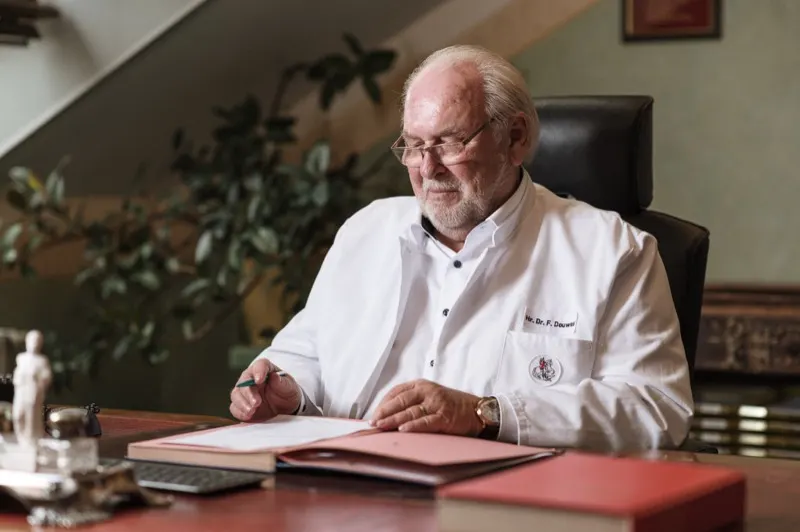
“The body has an extraordinary capacity to heal itself when given the right support. Our role as physicians is to identify what is blocking that process and to remove those barriers while strengthening the body’s own resources.”
— Friedrich Douwes M.D. (1945–2022), Founder of St. George Hospital
The order is fixed because it protects you: nobody is treated here before they have been measured.
You tell your story once, properly: history, symptoms, what has been tried and what you want back. On video before you travel, or in person.
Blood is drawn on your first morning. Laboratory panels, a review of your imaging and specialised tests show what is out of balance and how far the disease has gone.
Your physician sits down with you and explains each proposed therapy: why it is there, how strong its evidence is, and what we will measure to see whether it is working.
One to three weeks on the ward, with a schedule for each day, a physician who sees you, and values that are repeated so the plan can be adjusted while you are still here.
A discharge conversation, a written home protocol and a follow-up schedule. You leave with a report your own physician can act on, and with our contact details.
A video consultation in English before you travel. A physician reviews your findings first; we reply by email within one business day (Mon–Fri).
Mon–Thu 08:00–17:00, Fri 08:00–14:00 (CET/CEST)+49 8061 398-0info@clinicum-stgeorg.de
St. George Hospital is a specialist hospital, not an emergency department. In a medical emergency in Germany, dial 112.