
Immunological Treatment
Immune therapy
Immune therapy at St. George Hospital means thymus peptides, mistletoe extract (Viscum album) and, in selected patients, dendritic cell preparations made from your own blood. They are given on our ward as one module of a treatment plan written from your findings; in cancer they run alongside standard oncology, never instead of it.
What immune therapy means at St. George Hospital
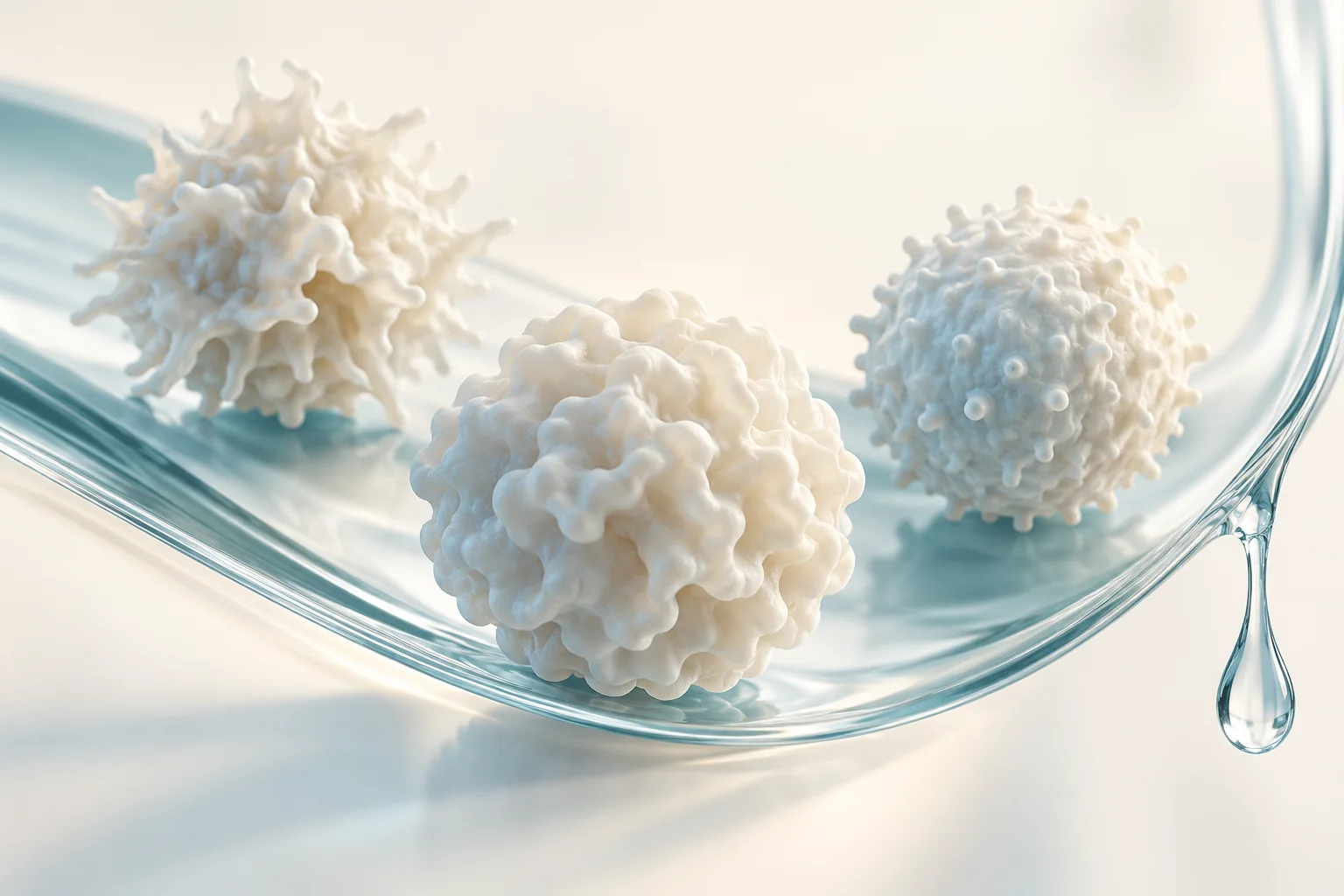
Immune therapy here is a group of treatments that act on the immune system itself: thymus peptides, mistletoe extract (Viscum album) and, in selected patients, dendritic cell preparations made from your own blood. They belong to our infusion and immune therapies and are given on the ward as one module of a plan written from your findings, never as a stand-alone course.
In oncology these treatments are complementary to standard oncology. Surgery, chemotherapy and radiotherapy stay in place; immune therapy runs alongside them with the aim of supporting tolerance of treatment and quality of life. In chronic infections such as Lyme disease and in post-viral fatigue the aim is different: to support a T-cell response that the laboratory shows to be weak or disordered.
Three mechanisms are in use. Thymus peptides, above all thymosin alpha 1, act on T-cell maturation and have been studied in immunocompromised states, chronic viral infections and as adjuncts in cancer treatment (Dominari et al., World J Virol, 2020). Mistletoe extracts contain lectins and viscotoxins that trigger cytokine release and a measurable immune reaction at the injection site; they have been part of German integrative oncology for decades. Dendritic cell preparations take antigen-presenting cells from your blood, load them in the laboratory with material from your tumor, and return them by injection so that the immune system is shown what it is meant to recognize.
Which conditions it is used for
Our physicians consider immune therapy in four settings, always as one part of a wider plan and never on the basis of the diagnosis alone. The immune laboratory from the first days of your stay decides whether stimulation, regulation or neither is the right direction.
- Cancer, alongside surgery, chemotherapy and radiotherapy, with mistletoe as the most used component and dendritic cell preparations in selected solid tumors
- Chronic Lyme disease and co-infections, where thymus peptides support the T-cell response during antimicrobial therapy and hyperthermia
- Post-COVID and other post-viral syndromes with persistent immune activation or exhaustion in the laboratory
- Chronic fatigue with documented immune dysfunction, where the aim is regulation rather than stimulation
- Autoimmune conditions in which the immune response needs to be regulated; here stimulating components are left out
Immune-stimulating treatment is not given during an acute febrile infection, in known hypersensitivity to the preparation, or during pregnancy. Patients on immunosuppressive medication after a transplant, and patients with leukemia or lymphoma in whom stimulation of lymphocytes could be unwanted, are assessed by our oncology team before anything is planned. Dendritic cell preparations need a tumor sample or defined antigens and adequate bone-marrow function; without them we do not offer the treatment.
How a session runs on our ward
- On the first or second day of your stay a nurse draws the baseline immune laboratory: lymphocyte subsets including CD4 and CD8 counts, NK cells and a cytokine panel. Your physician reads the results before the first dose and writes the schedule into your plan.
- Thymus peptides are given as a subcutaneous injection, or as a short infusion when combined with other agents. The injection takes a minute; a nurse stays with you for the first dose.
- Mistletoe is injected under the skin of the abdomen or thigh, usually three times a week, starting at a low dose and stepping up. The skin reaction at the injection site and your temperature in the evening tell the physician where to set the dose. A temperature above 38 °C / 100.4 °F is reported to the ward physician the same day.
- For dendritic cell preparations a blood sample is taken at the start of the stay and processed in the laboratory for one to two weeks. The injection comes later, often in the second or third week, and follow-up injections after you are home are set out in the written plan.
- Infusion-based combinations run 1–2 hours through an IV line in a treatment chair. You can read, rest or talk; a nurse checks on you during the infusion.
- Afterwards you return to your schedule. The immune laboratory is repeated in the second or third week so the course can be compared with the baseline.
Evidence and safety, graded
The evidence is moderate for quality of life with mistletoe in cancer and limited for survival. Side effects are mostly local, and every patient is screened for the exclusions before the first dose.
Show studies, risks and side effects
The evidence is moderate for quality of life with mistletoe in cancer. A systematic review and meta-analysis of 26 publications with 30 data sets found a pooled effect on global quality of life of d = 0.61 in favor of mistletoe against control, with the authors noting that the studies were heterogeneous (Loef et al., BMC Complement Med Ther, 2020).
For survival the evidence is limited. A meta-analysis of eleven randomized trials of non-fermented extracts reported a pooled hazard ratio of 0.81, but the effect was no longer significant when trials with active comparators were included, and the authors graded the risk of bias as moderate to high and asked for high-quality randomized trials (Loef et al., Integr Cancer Ther, 2022). The best-known single trial randomized 220 patients with advanced pancreatic cancer to mistletoe or no antineoplastic therapy, both with best supportive care, and reported a median overall survival of 4.8 against 2.7 months (Tröger et al., Eur J Cancer, 2013). It was open-label and single-center, and because the control arm received no chemotherapy it does not tell us what mistletoe adds to standard treatment.
For thymus peptides the evidence is moderate in licensed indications such as chronic hepatitis B in several countries and emerging elsewhere; controlled trials in chronic Lyme disease and post-viral fatigue have not been published, and our use there rests on the immune laboratory and clinical experience. For dendritic cell preparations the evidence is limited: a 2024 systematic review and meta-analysis of 36 studies of cell-based cancer vaccines found largely negative trials and no overall clinical benefit, alongside individual patients with measurable immune and clinical responses (Tiwari et al., Hum Vaccin Immunother, 2024). Dendritic cell therapy at St. George Hospital is therefore an individual treatment attempt decided with the patient after medical consultation.
What the evidence does not show: that any of these treatments shrinks a tumor on its own or replaces surgery, chemotherapy or radiotherapy.
Side effects are mostly local. Mistletoe causes redness and warmth at the injection site and a rise in temperature in the first days; allergic reactions are rare and the first dose is given with a nurse present. Thymus peptides cause occasional injection-site reactions. After a dendritic cell injection some patients have a day of flu-like symptoms. Every patient is screened for the exclusions above before the first dose.
How it fits your program
Immune therapy is rarely the main therapy of a stay. In oncology, Chief Physician Martin Rößner M.D. and the clinical team oversee day-to-day treatment using protocols developed under Julian Douwes M.D.’s medical direction. Depending on your plan, immune therapy may be combined with high-dose vitamin C infusions, locoregional or whole-body hyperthermia and ozone therapy, timed around the chemotherapy cycles agreed with your oncologist at home. The combination is written as a weekly schedule, and the immune laboratory repeated in week two or three shows whether to continue, adjust or stop a component.
In the Lyme and post-viral programs, thymus peptides run alongside antimicrobial therapy, whole-body hyperthermia and hyperbaric oxygen therapy, and in selected cases methylene blue infusions. Where fatigue dominates, NAD+ infusions and the detoxification therapies are added from the same plan. Two to three weeks as an inpatient is the usual frame, with the schedule set after the work-up.
For cancer patients the full set of modules, the length of stay and the way we coordinate with the oncologist at home are described in the integrative oncology program in Germany.
Costs and billing
You receive a written, itemized cost overview after a physician has read your findings and before anything is booked. Costs are a package price plus individual add-ons, and a deposit is paid before admission; immune therapy appears as its own block, and a dendritic cell preparation is listed as a separate laboratory item because of its external processing. Treatment is self-pay, and the invoice is itemized in English with diagnoses and procedure descriptions for out-of-network review. Details are on costs and insurance; the path from first email to arrival at Munich Airport is on information for international patients.
Questions patients ask
Does immune therapy replace chemotherapy, surgery or radiotherapy?
No. At St. George Hospital immune therapy is complementary to standard oncology. Surgery, chemotherapy and radiotherapy remain the treatment of the tumor; mistletoe, thymus peptides and dendritic cell preparations run alongside them with the aim of supporting tolerance of treatment and quality of life. Our oncologists coordinate the timing with your treating oncologist at home.
What side effects does mistletoe therapy have?
A local reaction at the injection site is expected: redness and mild warmth up to a few centimeters across, sometimes itching. A temperature rise after the injection is common in the first days. Both are used to set your dose. Allergic reactions are rare; the first dose is always given on the ward with a nurse present, and the dose is escalated step by step.
Is dendritic cell therapy an established treatment?
No. Dendritic cell preparations are an individual treatment attempt decided with you after medical consultation. A 2024 meta-analysis of cell-based cancer vaccines found no overall clinical benefit across trials, with individual responses in some patients. We say that plainly before you decide, and we only offer it where a tumor sample or defined antigens are available.
How do you know whether the therapy is doing anything?
We draw immune laboratory values (lymphocyte subsets, NK cell count, a cytokine panel) on the first or second day of your stay, before the first dose, and repeat them in the second or third week. Alongside the numbers we record fatigue, sleep and appetite with the same questionnaires each week, so you and your physician see the course rather than an impression.
Can I continue immune therapy at home?
Mistletoe and thymus peptide injections can be continued at home after your physician has set the dose and shown you or a relative how to inject. You receive the prescription, the schedule and a letter for your physician at home. Dendritic cell preparations stay with our laboratory; follow-up injections are set out in the written plan.
How much does immune therapy cost?
You receive a written, itemized cost overview after a physician has read your findings. The written cost overview shows the package price plus the individual add-ons your plan needs. Treatment is self-pay; the invoice is written in English for out-of-network review.
Write to the International Office with a short history; it requests your findings afterwards. A physician reads them before the video consultation and tells you whether immune therapy belongs in your plan.
References
- Quality of life in cancer patients treated with mistletoe: a systematic review and meta-analysis. BMC Complement Med Ther 2020. PMID 32690087
- Survival of cancer patients treated with non-fermented mistletoe extract: a systematic review and meta-analysis. Integr Cancer Ther 2022. PMID 36324298
- Viscum album [L.] extract therapy in patients with locally advanced or metastatic pancreatic cancer: a randomised clinical trial on overall survival. Eur J Cancer 2013. PMID 23890767
- Thymosin alpha 1: a comprehensive review of the literature. World J Virol 2020. PMID 33362999
- Utility of cell-based vaccines as cancer therapy: systematic review and meta-analysis. Hum Vaccin Immunother 2024. PMID 38544385
Send a free inquiry
The initial inquiry is free of charge. The International Office reviews your message and your case directly and gets back to you.
- Phone
- +49 8061 398-0
- Hours
- Mon–Thu 08:00–17:00, Fri 08:00–14:00 German time (CET/CEST); in the US Mon–Thu 2–11 a.m. ET, Fri 2–8 a.m. ET.
Munich Airport (MUC), about 60 minutes by car.