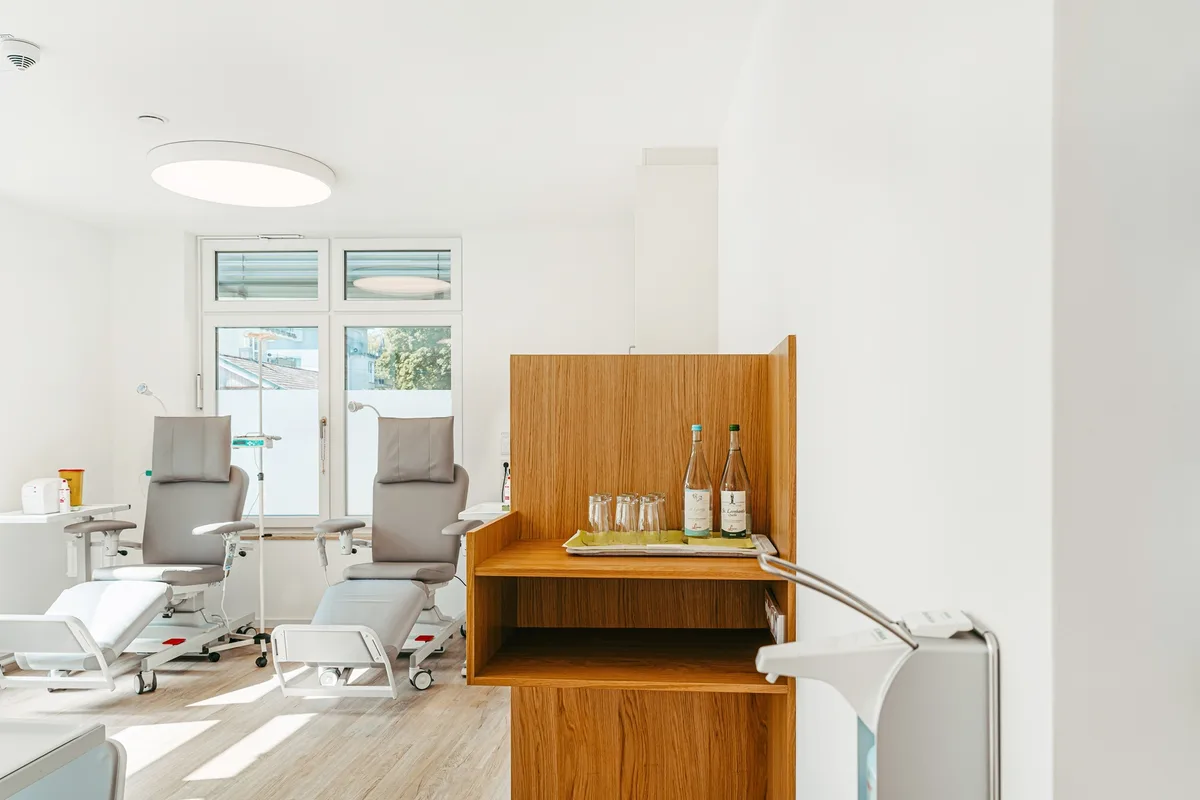
St. George Hospital runs a physician-supervised inpatient detoxification program that starts with measurement: blood and urine testing for heavy metals and environmental toxins, and an assessment of liver, kidney and gut function. Chelation is given only where a burden has been measured; the rest of the program supports the body's own elimination routes.
Is this you?
You eat well, you sleep, you train, and something still feels off.
Maybe it started after years in an old building, a career around solvents, or a mouth full of amalgam. Your routine labs are fine, your energy is not, and "detox" online means juice cleanses and foot pads. You want the medical version, with measurements. St. George Hospital offers that as an inpatient program inside its longevity and preventive medicine work, built from the detoxification therapies on our ward and the infusion unit.
The problem
The invisible toxic burden
Exposure is ordinary. Mercury from amalgam fillings and large predatory fish, lead from old paint, pipes and some imported ceramics, cadmium from tobacco and certain soils, arsenic from groundwater and rice, pesticide residues in food, endocrine disruptors in plastics and personal-care products. Most of it is cleared; some of it is stored, in bone, kidney, liver and fat, for years.
The mechanisms are well described. Mercury, lead, chromium, cadmium and arsenic share a common pathway: they generate reactive oxygen species, weaken the antioxidant defense, inactivate enzymes and disturb cell growth and repair, with some binding selectively to specific proteins, as in lead's effect on heme synthesis (Balali-Mood et al., Front Pharmacol, 2021). That is the biological basis for symptoms such as fatigue, concentration problems, neuropathy and hormonal disturbance in people with a real burden. It is not evidence that every person with those symptoms carries one, which is why the program begins with testing rather than treatment. Our article on heavy metal toxicity symptoms goes through the clinical picture metal by metal.
Measurement
Testing comes first, and what a provocation test cannot tell you
We measure metals in unprovoked blood and urine, read against established population reference ranges, and we take a detailed exposure history. Where the history points to a specific pollutant we add it: pesticide metabolites, bisphenols, phthalates, solvents. Liver enzymes, kidney function, electrolytes, zinc, selenium and a full blood count are part of the same draw, because they decide whether chelation is safe and which chelator fits. The environmental toxin testing guide explains each panel.
A "provoked" or "challenge" urine test gives a chelator first and collects urine afterwards. The American College of Medical Toxicology has reviewed this practice and concluded that there is no standard, validated challenge test, that mercury appears in the urine of most people after a chelator regardless of exposure history, that the results are compared with reference ranges built for unprovoked samples, and that the test does not reveal a body burden from remote exposure (Ruha, J Med Toxicol, 2013). We state that plainly because the test is widely sold. A provocation test alone does not establish a burden here, and a raised value after a chelator does not by itself put chelation in your plan. If the unprovoked values and the history are normal, we say so.
Evidence
Where the evidence stands
Chelation for confirmed metal poisoning is standard medicine, with decades of use and clear dosing for lead, mercury and arsenic; the evidence there is strong, and the choice of DMPS, DMSA or EDTA follows the metal found. The contested question is chelation outside confirmed poisoning, and the two largest trials answer it in opposite directions.
The Trial to Assess Chelation Therapy randomized 1,708 patients with a previous myocardial infarction to 40 infusions of disodium EDTA with vitamins or placebo. The composite of death, reinfarction, stroke, revascularization or hospitalization for angina occurred in 26 percent of the chelation group and 30 percent of the placebo group, a modest relative reduction, with no effect on total mortality (Lamas et al., JAMA, 2013). The replication trial, TACT2, enrolled 959 patients with diabetes and a previous infarction, the subgroup that had done best in the first trial. Chelation lowered median blood lead from 9.0 to 3.5 µg/L, and the primary end point did not differ between chelation and placebo (Lamas et al., JAMA, 2024). We grade chelation for cardiovascular prevention as limited, and we do not offer it for that purpose. Our article on chelation therapy for heavy metal detox goes through the agents and the trials in more detail.
Sweating is the other route the program uses. A systematic review of 24 studies found that arsenic, cadmium, lead and mercury are all excreted in sweat, that in people with higher exposure sweat concentrations generally exceeded plasma or urine, and that dermal excretion can match daily urinary excretion; the authors also noted that no adequately sized trial of sauna as a treatment exists (Sears et al., J Environ Public Health, 2012). We grade that as emerging. What the evidence does not show is that any elimination therapy improves long-term health in people without a measured burden. Outside confirmed poisoning, the program is an individual treatment attempt decided with the patient after medical consultation.
The infusion room Clinicum St. Georg
Our protocol
Medical detoxification components
Which of these your plan contains follows from the testing. A patient with measured lead gets a different program from one whose burden is pesticide residues and a sluggish liver.
Chelation
Intravenous or oral DMPS, DMSA or EDTA, selected for the metal measured, given after kidney function is confirmed and with essential minerals replaced before and during the course. Dose and interval follow the toxicology protocols, and urine metals are re-measured to document what left the body.
Liver support
The liver runs the phase I and phase II pathways that make fat-soluble pollutants water-soluble. Intravenous glutathione, phosphatidylcholine and alpha-lipoic acid from the infusion program support those pathways while elimination is active.
H.E.L.P. apheresis
Extracorporeal filtration removes oxidized lipids, fibrinogen and inflammatory proteins from the plasma. In the detoxification program it is used where inflammation and poor microcirculation accompany the burden. What H.E.L.P. apheresis involves
Lymphatic drainage
Manual lymphatic drainage supports the return of interstitial fluid during active elimination. It is scheduled as a comfort and support measure, not as a therapy with its own evidence base.
Colon hydrotherapy
Pollutants excreted in bile reach the intestine and can be reabsorbed. Colon hydrotherapy, binding agents and probiotic restoration are used to limit that recirculation while liver support is running.
Infrared sauna and oxygen
Paced far-infrared sauna sessions with electrolyte and mineral replacement use the sweat route described above. Ozone therapy and IHHT are added where oxygen utilization and mitochondrial function are the targets.
The process
How the program runs
Toxin identification. In the first two to three days we take the exposure history, draw unprovoked blood and urine for metals and, where the history points there, pesticide and plastic metabolites. Results are read against established reference ranges.
Organ assessment. Liver, kidney, electrolyte and gut markers show whether the elimination pathways can process what a program would release. Abnormal kidney function changes the plan before anything is given.
Preparation. Zinc, selenium, magnesium and other minerals are replenished and liver support infusions start, so that elimination is not run on empty stores.
Active phase. Chelation where a burden was measured, apheresis, lymphatic drainage, colon hydrotherapy and sauna are scheduled across one to two weeks. Values that were abnormal at baseline are repeated in week two.
Restoration. Micronutrients are replenished, the gut is supported with probiotics, and you leave with a written home protocol and a date for repeat testing with your physician at home.
Patients admitted for another program, such as the Lyme program or the healthy aging program, usually have a detoxification block scheduled inside that stay; NAD+ infusions are often placed in the restoration phase.
Your written, itemized cost overview shows a package price plus individual add-ons. Treatment is self-pay; the invoice is itemized in English with diagnoses and procedure descriptions for out-of-network review. Details are on Costs and insurance and in the Information for international patients.
Questions
Frequently asked questions about the detoxification program
How do you know whether I have a heavy metal burden?
From unprovoked blood and urine samples read against established reference ranges, together with your exposure history: occupation, amalgam fillings, water source, diet, country of residence. Hair analysis and provoked urine tests are not used on their own to make the diagnosis, because neither has validated reference ranges. If the baseline values are normal, we tell you so and chelation is not part of your plan.
Is chelation safe?
Given intravenously or orally under physician supervision, with kidney function checked beforehand and essential minerals replaced, chelation has a low rate of serious side effects. The main risks are loss of zinc and other essential minerals, a drop in calcium with disodium EDTA given too fast, kidney strain and allergic reactions. We check kidney values and electrolytes during the course, and the chelator is matched to the metal found.
Can the program remove pesticides or plastics as well as metals?
Fat-soluble pollutants such as pesticide residues and some endocrine disruptors are not bound by chelators. For these the program relies on liver support, bile flow and the gut, with binding agents and colon hydrotherapy to limit reabsorption, and on sweating. The evidence that these routes change long-term body burden is limited, which is why we measure what can be measured before and after.
How long does a detoxification program take?
Testing takes the first two to three days. The active phase runs one to two weeks as an inpatient. Patients who come for another program, such as the Lyme or Post-COVID program, usually have a detoxification block scheduled inside that stay rather than a separate admission. A home protocol and a date for repeat testing are part of the discharge letter.
How much does the detoxification program cost?
Your written, itemized cost overview shows a package price plus individual add-ons. You receive it after a physician has read your findings and before anything is booked. Treatment is self-pay; the invoice is itemized in English for out-of-network review.
If you want to know whether a measured burden is behind your symptoms, write a short inquiry to the International Office, free of charge; it asks for your findings afterwards. A physician reads them before the video consultation and tells you which tests are still needed and whether a detoxification block belongs in your plan. You can also read how a stay runs before you decide.
Toxic Mechanisms of Five Heavy Metals: Mercury, Lead, Chromium, Cadmium, and Arsenic.. Front Pharmacol 2021. PMID 33927623
Recommendations for provoked challenge urine testing.. J Med Toxicol 2013. PMID 24113861
Effect of disodium EDTA chelation regimen on cardiovascular events in patients with previous myocardial infarction: the TACT randomized trial.. JAMA 2013. PMID 23532240
Edetate Disodium-Based Chelation for Patients With a Previous Myocardial Infarction and Diabetes: TACT2 Randomized Clinical Trial.. JAMA 2024. PMID 39141382
Arsenic, cadmium, lead, and mercury in sweat: a systematic review.. J Environ Public Health 2012. PMID 22505948
Mon–Thu 08:00–17:00, Fri 08:00–14:00 German time (CET/CEST); in the US Mon–Thu 2–11 a.m. ET, Fri 2–8 a.m. ET.
Munich Airport (MUC), about 60 minutes by car.
Cookies for statistics. With your consent we use Google Analytics to see which pages are useful. You can change your choice at any time under “Cookie settings” in the footer. Privacy policy