
Low-Dose Chemotherapy
IPT chemotherapy
Insulin-potentiated therapy (IPT) is low-dose chemotherapy combined with insulin: a controlled dose of insulin is given first, a fraction of the standard chemotherapy dose follows while blood sugar is low, and glucose ends the session. St. George Hospital uses IPT alongside or after guideline oncology, after consultation with you and your oncologist, as an individual treatment attempt.
What is IPT chemotherapy?
IPT is chemotherapy at a reduced dose, given in a short window of low blood sugar that a controlled dose of insulin creates. St. George Hospital offers it inside its integrative oncology work, for patients who are under or have completed guideline treatment and whose oncologist and our physicians agree that a low-dose regimen is reasonable for them.
The rationale rests on two observations. Many tumor cells carry more insulin receptors than the healthy cells around them, and insulin changes how cells take up nutrients and some drugs. In laboratory work insulin increased the effect of methotrexate on breast cancer cells many times over. IPT applies this in the patient: insulin first, then a fraction of the standard chemotherapy dose while the blood sugar is low, then glucose to end the window. The hope is that the drug reaches the tumor in a useful concentration while the whole body receives less of it.
Whether this happens in people to a degree that changes the course of a cancer has not been shown in a large trial. That is why the hospital grades the evidence as limited and uses IPT as an addition to standard oncology, never as a replacement for it.
Who IPT is for, and who it is not for
The physician decides from your records, your oncologist's plan and your general condition whether IPT can be part of your program. It is considered for:
- Patients receiving guideline chemotherapy at home who want to add a low-dose cycle during a stay, with the oncologist's agreement
- Patients whose oncologist has stopped or reduced standard-dose chemotherapy because of side effects, and who are looking for a tolerable systemic component
- Patients who have completed guideline treatment for metastatic or recurrent disease and are weighing further systemic options
- Patients whose plan combines a systemic drug with whole-body hyperthermia or local-regional hyperthermia
IPT is not offered where guideline oncology recommends full-dose chemotherapy and you tolerate it; in that situation we advise you to follow your oncologist's regimen. It is not used in patients with unstable diabetes, adrenal insufficiency, severe heart or cerebrovascular disease, or in anyone who cannot safely go through a short period of low blood sugar. IPT is not part of guideline oncology; it is an individual treatment attempt decided with the patient after medical consultation.
Could this belong in your plan?
Send your pathology, your oncologist's treatment summary and your current medication list. A physician reads them before the video consultation and tells you whether a low-dose regimen is reasonable in your case and which drug it would use.
What a cycle is like
- The day before. Blood count, kidney and liver values and fasting glucose are checked. The physician confirms the drug and the dose from your plan. You are asked to eat normally the evening before and to come fasting in the morning.
- Before. A nurse places an IV line and takes a baseline glucose reading. A physician and a nurse stay at the chair for the whole session; glucose solution and food are ready beside you.
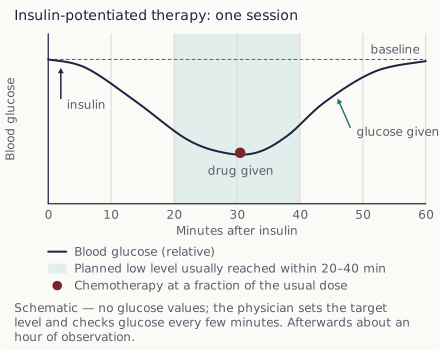
- Insulin. A weight-based dose of short-acting insulin is given. Blood sugar is measured every few minutes. As it falls you may feel hungry, warm, sweaty or shaky. This is expected and is the sign that the window is opening.
- The drug. When the planned glucose level is reached, usually within 20 to 40 minutes, the chemotherapy drug is given as a short infusion at a fraction of the standard dose. The substance is the one your tumor type calls for in standard regimens.
- Glucose. Glucose follows by mouth and by infusion, and the readings are watched until they are back in the normal range. You eat at the chair.
- Afterwards. Observation for about an hour, then rest. Most patients feel tired for the rest of the day. The whole session takes about two to three hours. Sessions are usually weekly, two to four in a stay of two to four weeks, and the physician reviews blood counts before each one.
Evidence and safety
The evidence for IPT is limited. The one randomized trial is small: Lasalvia-Prisco et al., Cancer Chemother Pharmacol, 2004 randomized 30 women with metastatic breast cancer that had stopped responding to standard chemotherapy and hormone therapy to methotrexate with insulin, methotrexate alone or insulin alone, ten per group, for two 21-day courses. The combination group most often had stable disease, while the two single-agent groups most often progressed, and the median increase in tumor size was lower with the combination. Thirty patients and two courses cannot establish a treatment, and the trial has not been repeated at scale.
The rest of the literature consists of case series, clinical observations and pharmacological studies of insulin and drug uptake. A 2019 commentary from the clinical pharmacology program of the US National Cancer Institute (Sissung et al., Lancet Oncol, 2019) questioned IPT and the state of its evidence; we think patients should know that this view exists. What the evidence does not show: no trial has compared IPT with standard-dose chemotherapy in any tumor type, so no one can tell you that a reduced dose works as well as the full dose, and the hospital does not claim it.
By comparison, the hyperthermia we combine with IPT has firmer ground: a randomized phase 3 trial added regional hyperthermia to chemotherapy in high-risk soft-tissue sarcoma and improved local progression-free survival (Issels et al., Lancet Oncol, 2010). That result belongs to the hyperthermia, not to IPT.
Safety rests on monitoring. The intended drop in blood sugar is the main risk, and it is handled by measuring glucose every few minutes with a physician and nurse at the chair and glucose ready to give. The chemotherapy drug keeps its own side-effect profile at the lower dose: nausea, fatigue and changes in blood counts occur, usually milder than at full dose, and blood counts are checked before every session. In our clinical experience most patients tolerate the sessions without needing to stop the cycle; that is an observation from our ward, not a trial result.
How it fits the program
IPT is a systemic component inside a plan that Dr. Martin Rößner, Chief Physician, and the clinical team write from your findings using protocols developed under Dr. Julian Douwes and coordinate with your oncologist at home. The hospital does not change your cancer medication without that coordination. On the ward IPT is combined most often with local-regional hyperthermia of the tumor region or with whole-body hyperthermia, with immune therapy such as mistletoe, and with supportive care for nausea, fatigue and nutrition.
How these elements are sequenced over a two to four week stay, and how the stay is coordinated with treatment at home, is described on the page for our integrative oncology program in Germany. The background article on low-dose chemotherapy and IPT covers the history of the method.
Costs
Treatment at St. George Hospital is self-pay. IPT is billed per session, including the drug, the monitoring and the physician time, inside the itemized estimate in EUR that you receive after a physician has read your findings. Costs are a package price plus individual add-ons, and a deposit is paid before admission. The invoice after the stay is itemized in English with diagnoses and procedure descriptions for an out-of-network claim. Details are on costs and insurance.
Questions patients ask about IPT
Is IPT a replacement for standard chemotherapy?
No. Where guideline oncology recommends full-dose chemotherapy, that is the treatment we advise you to take. IPT is used alongside or after guideline treatment, or for patients whose oncologist has stopped standard dosing because of side effects, and only after the two physicians have spoken. The evidence for IPT is limited.
What does a session feel like?
As the insulin lowers your blood sugar you may feel hungry, warm, sweaty or shaky for a short time. The physician watches the readings and gives the chemotherapy drug when the planned level is reached, then glucose by mouth and infusion. Most patients feel normal again within half an hour and eat afterwards.
Is IPT safe?
The main risk is the deliberate drop in blood sugar. It is managed by measuring glucose every few minutes with a physician and nurse at the chair and glucose ready to give. Patients with unstable diabetes, adrenal insufficiency or severe heart disease are excluded. The chemotherapy drug keeps its own side effects, at a lower dose.
Which chemotherapy drugs are used?
The drug follows your tumor type and what your oncologist has used or planned: the same substances as in standard regimens, at a fraction of the usual dose. The physician chooses the drug from your records and the current recommendation for your cancer, and writes the regimen into the plan before the first session.
How much does IPT cost?
This page lists no prices. IPT is billed per session, including the drug, the monitoring and the physician time, inside the itemized estimate you receive after a physician has read your findings. The cost overview is written and itemized. See costs and insurance.
If you are weighing a low-dose regimen, send your oncologist's treatment summary and your most recent blood work. A physician reads them before the video consultation and tells you in writing whether IPT is reasonable in your case.
References
- Insulin-induced enhancement of antitumoral response to methotrexate in breast cancer patients.. Cancer Chemother Pharmacol 2004. PMID 14655024
- Insulin potentiation therapy for cancer?. Lancet Oncol 2019. PMID 30712796
- Neo-adjuvant chemotherapy alone or with regional hyperthermia for localised high-risk soft-tissue sarcoma: a randomised phase 3 multicentre study.. Lancet Oncol 2010. PMID 20434400
Send a free inquiry
The initial inquiry is free of charge. The International Office reviews your message and your case directly and gets back to you.
- Phone
- +49 8061 398-0
- Hours
- Mon–Thu 08:00–17:00, Fri 08:00–14:00 German time (CET/CEST); in the US Mon–Thu 2–11 a.m. ET, Fri 2–8 a.m. ET.
Munich Airport (MUC), about 60 minutes by car.