
Is this you?

You want to know who these people are before you fly across an ocean.

A reasonable instinct. Any clinic can write a treatment page. Fewer can say how they arrived at their method, what they observed first, and what they changed along the way. You want the origin, not the brochure.

This page tells how the Lyme program at St. George Hospital began in 1994, what was observed, and how the protocol has developed since.

The Beginning

How the Lyme program began

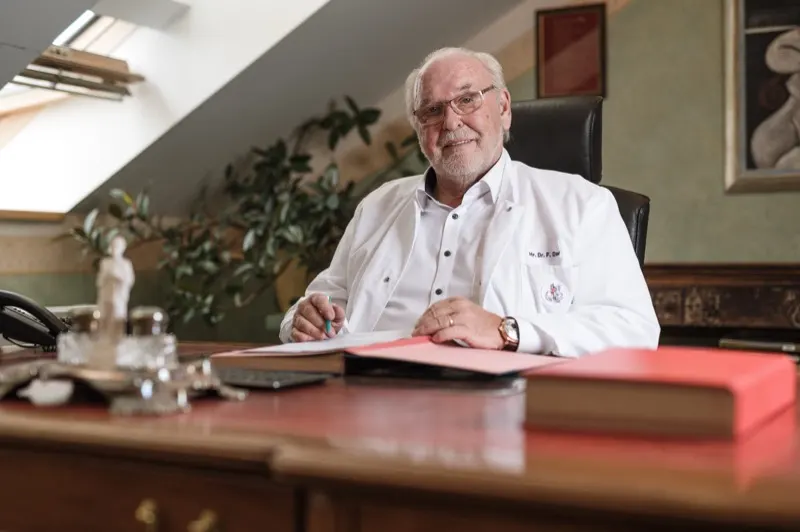
St. George Hospital was founded in 1991 by Friedrich Douwes M.D. (1945 to 2022) in Bad Aibling, Bavaria, on the conviction that complex chronic illnesses need an approach that combines conventional medicine with complementary therapies, guided by clinical experience and by what the patient reports.

The Lyme program did not come from a plan. In 1994 a patient with metastasized breast cancer arrived for oncological treatment, and Dr. Douwes treated her with whole-body hyperthermia as part of her cancer protocol. The next morning on rounds she told him something he never forgot.

She had undiagnosed Lyme disease, and the hyperthermia had improved her neurological symptoms overnight. Six months later a second cancer patient with undiagnosed Lyme disease reported the same after hyperthermia. Dr. Douwes began to investigate the connection; laboratory work published soon after showed that Borrelia burgdorferi is more vulnerable to antibiotics at raised temperature (Reisinger et al., 1996). That observation became the basis of the program that runs today.

Dr. Friedrich Douwes M.D., founder of St. George Hospital Germany (1945–2022)
Milestones

Key milestones in our Lyme program

"Dr. Douwes, what did you do? You put the sun back in my brain."

A cancer patient with undiagnosed Lyme disease, after her first whole-body hyperthermia session, 1994

1

1991: Hospital Founded

Dr. Friedrich Douwes establishes St. George Hospital in Bad Aibling, Bavaria, as a hospital for integrative medicine and the treatment of chronic diseases, with a focus on oncology and biological therapies.

2

1994: The Observation

A patient with metastasized breast cancer arrives for treatment. Dr. Douwes treats her with whole-body hyperthermia as part of her cancer protocol. The next morning on rounds she tells him: "Dr. Douwes, what did you do? You put the sun back in my brain." She had undiagnosed Lyme disease; the hyperthermia had improved her neurological symptoms.

3

1994: Confirmation

Six months later a second cancer patient with undiagnosed Lyme disease reports the same improvement in neurological symptoms after hyperthermia. Dr. Douwes begins researching the connection between heat and Borrelia.

4

1995: The Lyme Program Begins

From these observations, St. George Hospital begins treating Lyme disease patients with whole-body hyperthermia combined with antibiotic therapy given during the session, and writes its first dedicated Lyme protocol. The treatment and its measurements are described on the Lyme treatment page.

5

Late 1990s: Co-Infections and the First International Patients

The clinical team finds that many treatment-resistant Lyme patients carry co-infections, in particular Bartonella, Babesia and Ehrlichia. Co-infection testing is added to the standard work-up. Word spreads in the Lyme community, and patients begin traveling from across Europe, the United States and beyond.

6

2010s: The Multimodal Protocol

The clinical experience of two decades is written into the multimodal protocol. Intravenous laser therapy (photodynamic therapy), immune modulation and expanded supportive care are added. Findings are recorded before and after treatment, and the protocols are revised from them.

7

Today: The Modular Program

Under Julian Douwes M.D., Chief Medical Officer, the Lyme program has the modular structure used today: the core Lyme module, the co-infection module and the microbiome restore week. Patients from more than 60 countries have been treated here, with protocols that trace their origin to that morning in 1994.

When the Lyme program began, many physicians doubted that chronic Lyme disease existed. Three decades and more than 12,000 Lyme patients later, the hospital regards it as one of the most significant infectious diseases of our time, one that deserves the full attention of the medical community.

Lessons since 1995

What three decades have taught us

Chronic Lyme is real

In our clinical experience with thousands of patients, Borrelia infection can persist beyond a standard course of antibiotics and cause a disabling chronic illness. The research on persistence, summarized on the what is Lyme disease page, now describes what we observed clinically in the 1990s.

Co-Infections are the rule

Most chronic Lyme patients we see carry one or more co-infections. Treating Borrelia while ignoring Bartonella, Babesia or other co-pathogens does not hold. Testing for them is part of every work-up.

Standard treatment is not enough for everyone

A two to four week course of antibiotics is the standard for early Lyme disease and resolves most cases. For established chronic Lyme disease it is often not enough, because of the biology of Borrelia: it changes form, builds biofilms and evades the immune system, which calls for a plan with more than one component.

Every patient is different

There is no one-size-fits-all Lyme treatment. Each patient brings a different combination of infection, immune status, organ involvement, co-infections and treatment history. The work-up comes first, and the plan is written from it.

Multimodal treatment

No single therapy addresses every dimension of chronic Lyme disease. The plan combines treatments that act on the infection, support the immune system and help the body's own repair, as the multimodal protocol describes.

The patient must be heard

Too many Lyme patients have been dismissed, disbelieved or told their symptoms are psychological. "It is psychological" is a sentence about the limits of the tests that were run. Listening to the history is often more revealing than any single laboratory value, and clinical judgment stays part of every decision.

By the Numbers

Three decades in numbers

1991

Hospital Founded

12,000+Lyme Patients Since 1995
30,000+Whole-Body Hyperthermia Sessions
60+Countries of Origin
Looking Forward

The next chapter

After more than thirty years the program keeps changing, from new research, from the findings recorded before and after treatment, and from what is learned about tick-borne illness elsewhere.

Current areas of work:

  • Biomarker research for more precise treatment monitoring
  • Refinement of the hyperthermia protocols from the hospital's treatment data
  • New antimicrobial strategies for biofilm-associated infection
  • The neurological impact of chronic Lyme disease
  • Post-treatment maintenance protocols against relapse
  • Collaboration with research institutions abroad

For patients from abroad the program runs as inpatient Lyme disease treatment in Germany: a video consultation in English before you travel, a written proposal, and two to five weeks on the ward in Bad Aibling, an hour from Munich Airport.

FREQUENTLY ASKED QUESTIONS

Common questions about the Lyme program's history

When did St. George Hospital start treating Lyme disease?

The hospital was founded in 1991 as a hospital for integrative oncology. The Lyme program followed the observation of 1994 and began in 1995, when the first patients were treated with whole-body hyperthermia combined with antibiotics. Since then more than 12,000 patients with chronic Lyme disease have been treated here.

Who founded the hospital?

Friedrich Douwes M.D. (1945 to 2022) founded St. George Hospital in Bad Aibling, Bavaria, in 1991. Today his son, Julian Douwes M.D., is Chief Medical Officer and leads the program with the physician team.

Why hyperthermia for Lyme disease?

Because the first observation was made during hyperthermia, and because laboratory work has shown Borrelia to be sensitive to heat in combination with antibiotics. Whole-body hyperthermia with antibiotics given during the session is one component of the plan, never the whole plan. Its use in Lyme disease is an individual treatment attempt, decided with the patient after medical consultation.

How has the program changed since 1995?

Co-infection testing was added in the late 1990s after treatment-resistant patients turned out to carry Bartonella, Babesia or Ehrlichia. The 2010s brought the multimodal protocol with photodynamic therapy and immune support. Today the program runs in modules: core Lyme (two weeks), co-infection module and microbiome restore week, chosen from the work-up.

Related therapies

Our Lyme disease therapies

Ozone therapy

One of the original biological therapies in the Lyme protocol, used for its antimicrobial and immune-modulating effects.

What ozone therapy involves →
PATIENT EXPERIENCES

Lasting results across decades

International Patient

8 Years Post-Treatment

"I came for treatment for an inoperable Chondrosarcoma which was classed as terminal in 1998. I was 28 years old. I am now 55 with 4 beautiful children."

International Patient, Australia

27 years after treatment

References

  1. Antibiotics and increased temperature against Borrelia burgdorferi in vitro. Scand J Infect Dis 1996. PMID 8792482

Send a free inquiry

The initial inquiry is free of charge. The International Office reviews your message and your case directly and gets back to you.

Hours
Mon–Thu 08:00–17:00, Fri 08:00–14:00 German time (CET/CEST); in the US Mon–Thu 2–11 a.m. ET, Fri 2–8 a.m. ET.

Munich Airport (MUC), about 60 minutes by car.

CallSend a free inquiry