
Blood Purification
Red Blood Cell Exchange
An apheresis procedure that removes the patient’s red blood cells and replaces them with healthy donor erythrocytes, used to treat conditions affecting red blood cell function or carrying intracellular pathogens.
What Is Red Blood Cell Exchange?
Red blood cell exchange (erythrocytapheresis) is a specialized apheresis procedure that selectively removes the patient’s red blood cells and replaces them with compatible donor erythrocytes. Unlike simple transfusion, RBC exchange does not increase total blood volume or viscosity, making it safer for patients with conditions where volume overload is a concern.
This procedure is particularly valuable when the patient’s own red blood cells are dysfunctional, infected, or carry abnormal hemoglobin variants.
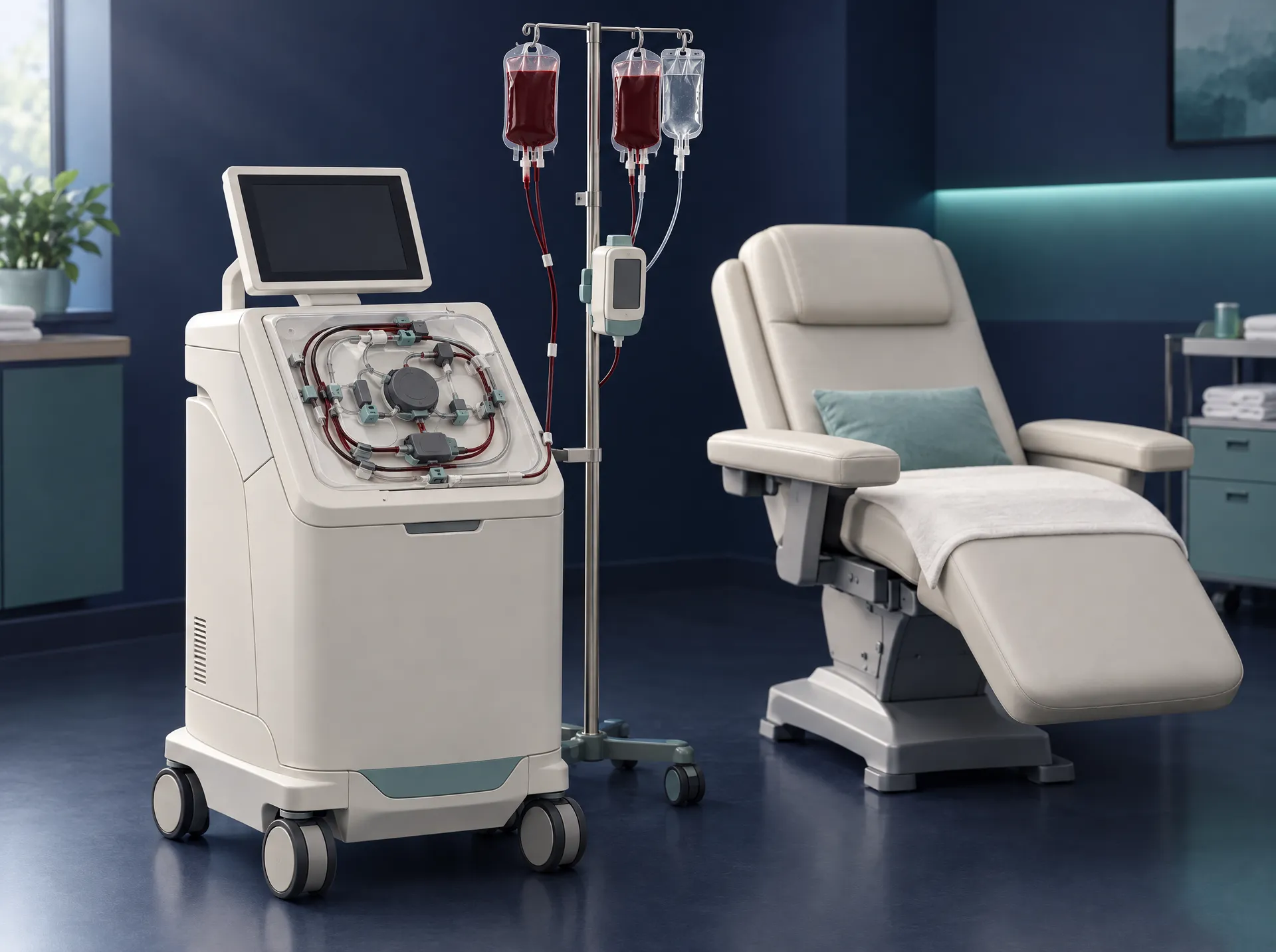
How Does It Work?
Blood is drawn from a venous access point and processed in an apheresis machine that separates red blood cells from plasma, white blood cells, and platelets. The patient’s red blood cells are removed and replaced with typed and crossmatched donor red blood cells. The patient’s own plasma and other blood components are returned.
The procedure can achieve replacement of 60-90% of the patient’s red blood cell mass in a single session, depending on the clinical goals. The process is automated and continuously monitored to maintain hemodynamic stability.
Conditions Treated
- Sickle cell disease (acute crises and chronic management)
- Severe malaria with high parasitaemia
- Babesiosis and other intraerythrocytic infections
- Polycythemia vera
- Severe autoimmune hemolytic anemia
Could this belong in your plan?
That depends on your findings, not on the therapy. Send what you have with a short history; a physician reads it before the video call and tells you whether this treatment belongs in your program.
What a session feels like
- Before A nurse establishes venous access and confirms the volume of cells to be exchanged, which decides how long you will be in the chair.
- During Between 1.5 and 3 hours. The exchange runs automatically; your blood pressure, pulse and circulation are watched continuously. Beyond the initial needle there is little to feel.
- Afterwards You rest briefly, then return to your room and the rest of your schedule.
Evidence & Safety
Red blood cell exchange is a well-established medical procedure with Category I (first-line) indications for sickle cell disease management according to the American Society for Apheresis guidelines. It is also an accepted treatment for severe parasitic infections affecting red blood cells. The procedure carries risks inherent to any blood transfusion, including allergic reactions and transfusion-related complications, which are minimized through careful donor matching and monitoring protocols.
Request a consultation
A video consultation in English before you travel. A physician reviews your findings first; we reply by email within one business day (Mon–Fri).
Mon–Thu 08:00–17:00, Fri 08:00–14:00 (CET/CEST)+49 8061 398-0info@clinicum-stgeorg.de
St. George Hospital is a specialist hospital, not an emergency department. In a medical emergency in Germany, dial 112.