
Intestinal Cleansing
Colon hydrotherapy
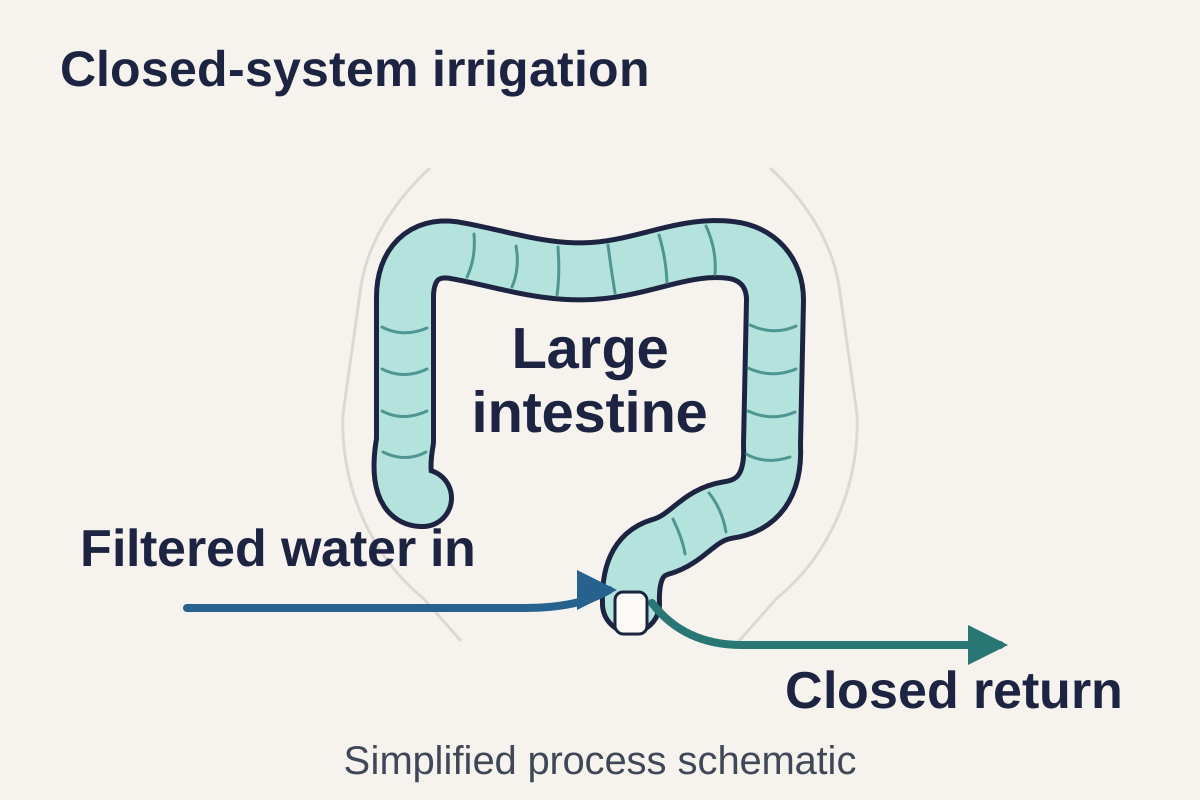
Colon hydrotherapy flushes the large intestine with temperature-controlled, filtered water through a closed system, in a private treatment room with a trained therapist. St. George Hospital uses it as a supportive measure inside the inpatient detoxification program and to prepare the gut before microbiome therapies.
What is colon hydrotherapy?
Colon hydrotherapy, also called colonic irrigation, introduces filtered, body-temperature water into the large intestine at low pressure through a small disposable rectal tube. The water softens and loosens stool, mucus and gas; the colon then releases them through the same closed circuit, with no odor and no exposure. The cycle is repeated several times in a session. It is one of the detoxification therapies at St. George Hospital, and we are precise about its job: it cleans the bowel. It does not remove substances from blood or tissue; that work is done by liver, kidneys and, where indicated, apheresis.
The physiology is simple. Warm water distends the colon wall and triggers peristalsis, the muscular wave that moves contents toward the rectum. Gentle abdominal massage during the session supports the same reflex. The result is an emptied colon, which matters for two things we do on the ward: preparing the intestinal environment before probiotic or microbiome therapies, and relieving constipation and bloating that appear during antibiotic or antimicrobial treatment.
What conditions is it used for?
Used for bowel preparation before a microbiome transfer and for constipation during antimicrobial or detoxification phases. It is not standard care for any condition, and a physician reviews your bowel history first.
Show when it is used
- Bowel preparation before microbiome transfer or intensive probiotic therapy
- Constipation and bloating during antibiotic or antimicrobial phases of the Lyme program
- Supportive measure inside the inpatient detoxification program
- Chronic constipation and intestinal dysbiosis, after bowel disease has been excluded
- Gut support for patients with chronic fatigue or Post-COVID whose digestion has slowed with inactivity
Colon hydrotherapy is not part of standard care for any of these conditions. We offer it as an individual treatment attempt decided with the patient after medical consultation, and only after a physician has reviewed your bowel history.
Could this belong in your plan?
That depends on your findings. Write to the International Office with a short history, including any bowel disease or surgery; it requests your records afterwards, and a physician reviews them before the video consultation and tells you whether colon hydrotherapy belongs in your program.
How a session runs
Check
Your physician rules out active inflammatory bowel disease, recent bowel surgery, severe hemorrhoids or a known colorectal tumor. You eat lightly the evening before.
Setting up
In a private treatment room a trained therapist explains the unit and places a small, single-use rectal tube. The system is closed from then on.
The session
Filtered water at body temperature flows in at low pressure and drains through the closed line, cycle after cycle. Mild cramping can come and go; you can stop anytime.
Afterwards
You drink water and rest for an hour. Electrolytes are checked with the routine labs if a second session is planned.
Evidence and safety
The evidence is limited. No rigorous controlled trials support colonic cleansing for general health, and adverse effects have been reported, mostly in unsupervised settings and in people with undiagnosed bowel disease.
Show studies, risks and side effects
The evidence for colon hydrotherapy is limited. A systematic review in the American Journal of Gastroenterology found no methodologically rigorous controlled trials supporting colonic cleansing for general health promotion, and a number of case reports describing adverse effects, mostly from unsupervised settings and in people with undiagnosed bowel disease (Acosta et al., Am J Gastroenterol, 2009). That review is the reason we do not sell colon hydrotherapy as a stand-alone detox, and why screening comes first.
The picture is different for defined bowel indications. Italian coloproctologists have argued for moving colonic hydrotherapy from the beauty center into the clinic under medical criteria (Bazzocchi et al., Tech Coloproctol, 2017), and a 2024 position paper sets out when transanal irrigation can help patients with chronic functional constipation and evacuation disorders defined by the Rome criteria (Bazzocchi et al., Dig Liver Dis, 2024). A pilot study of a colonic irrigation system in irritable bowel syndrome reported less abdominal pain, more regular stool consistency and only mild adverse events, while noting that larger controlled studies are needed (Hsu et al., Tech Coloproctol, 2016). We grade the evidence for symptom relief in constipation-type disorders as emerging. What the evidence does not show is any effect on toxin levels in blood or tissue.
Contraindications and side effects
- Active inflammatory bowel disease (Crohn's disease, ulcerative colitis), acute diverticulitis
- Bowel or rectal surgery in the last months, known colorectal tumor, bowel perforation or fistula
- Severe hemorrhoids, anal fissure, rectal bleeding of unknown cause
- Severe heart or kidney failure, where fluid and electrolyte shifts matter; pregnancy
In the hospital setting side effects are mild: cramping, a brief feeling of weakness, nausea in a few patients. Repeated sessions in short succession can disturb electrolytes and the gut flora, which is why we keep the number of sessions per stay small and check labs before a repeat. Equipment is single-use where it touches the patient and the unit is disinfected between sessions.
How it fits the program
In the detoxification program colon hydrotherapy is a supportive measure, scheduled once the physician has the baseline labs and before intensive probiotic restoration. It is combined with glutathione and vitamin infusions, ozone therapy and, for comfort, the ionic footbath; where oxidized lipids and inflammatory proteins are the measured problem, H.E.L.P. apheresis does the filtering that no bowel flush can. In the Lyme program it is used when antimicrobial treatment slows the bowel. Oral binders and a fiber plan from the ward dietitian follow each session so that the gut flora rebuilds rather than empties.
Costs: colon hydrotherapy is billed per session as a therapy block within your written, itemized cost overview. Costs are a package price plus individual add-ons, and a deposit is paid before admission. Treatment is self-pay; the invoice is itemized in English with diagnoses and procedure descriptions for out-of-network review. See Costs and insurance and the Information for international patients.
Frequently asked questions about colon hydrotherapy
Is colon hydrotherapy safe?
In a hospital setting, with a closed system, single-use tubing, controlled temperature and low pressure, and after a physician has excluded bowel disease, the risk is low. The reported complications in the literature come mostly from unsupervised settings and from people with undiagnosed bowel conditions. That is why we screen first and keep the therapist in the room for the whole session.
Does it hurt?
Most patients describe warmth, pressure and the urge to release, with mild cramping that comes and goes as the water cycles. It is not painful. The therapist lowers the flow or pauses whenever you ask. A gentle abdominal massage during the session helps the colon release, and you may feel emptied and a little tired for an hour afterwards.
Does colon hydrotherapy remove toxins from my body?
It removes stool, gas and mucus from the large intestine. It does not pull toxins out of blood or tissue, and the published literature does not support colon cleansing as a general detox measure. In our program it has a narrower job: emptying the bowel before microbiome therapies and reducing bloating while other therapies do the measurable work.
How many sessions are usual?
Usually one, at most a few, during a 2–4 week stay. A single session is typical before a microbiome transfer; a second may follow if constipation returns during antibiotic or antimicrobial treatment. We do not run weekly series for general wellness, because the evidence does not support it and repeated flushing can disturb electrolytes and gut flora.
How much does it cost?
Colon hydrotherapy appears in your itemized cost overview as an add-on to the package price. You receive the estimate in EUR after a physician has read your findings. Treatment is self-pay; the invoice is itemized in English with procedure descriptions for out-of-network review.
If your bowel has slowed during treatment elsewhere, or you are planning a detoxification stay and want to know what belongs in it, write a short inquiry to the International Office, free of charge; it asks for your findings afterwards. A physician reads them before the video consultation and tells you whether colon hydrotherapy has a place in your plan. You can also read how a stay runs first.
References
- Clinical effects of colonic cleansing for general health promotion: a systematic review.. Am J Gastroenterol 2009. PMID 19724266
- Irrigation, lavage, colonic hydrotherapy: from beauty center to clinic?. Tech Coloproctol 2017. PMID 28091749
- Treatment of irritable bowel syndrome with a novel colonic irrigation system: a pilot study.. Tech Coloproctol 2016. PMID 27194235
- Position paper on transanal irrigation in chronic non-organic constipation.. Dig Liver Dis 2024. PMID 38461046
Send a free inquiry
The initial inquiry is free of charge. The International Office reviews your message and your case directly and gets back to you.
- Phone
- +49 8061 398-0
- Hours
- Mon–Thu 08:00–17:00, Fri 08:00–14:00 German time (CET/CEST); in the US Mon–Thu 2–11 a.m. ET, Fri 2–8 a.m. ET.
Munich Airport (MUC), about 60 minutes by car.