 By Julian Douwes M.D.
Understanding NAD+ IV therapy pricing
Nicotinamide adenine dinucleotide (NAD+) intravenous therapy has gained significant attention as a treatment for chronic fatigue, neurological conditions, addiction recovery, and age-related decline. As interest grows, one of the most common questions patients ask is straightforward: how much does NAD+ IV therapy cost?
The answer depends on where you receive treatment, what dosage is administered, how many sessions are recommended, and whether NAD+ is delivered as a standalone infusion or as part of a comprehensive medical program. This article provides a transparent overview of NAD+ IV therapy costs across different settings — including how pricing at St. George Hospital in Germany compares to clinics in the United States and elsewhere.
What is NAD+ IV therapy?
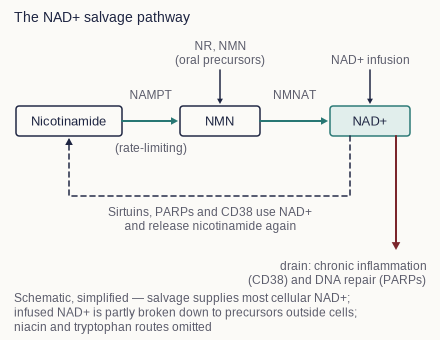
NAD+ is a coenzyme present in every living cell, essential for mitochondrial energy production, DNA repair, cellular signaling, and the regulation of aging-related pathways including sirtuins. NAD+ levels decline naturally with age and are further depleted by chronic illness, infection, oxidative stress, and substance use.
Intravenous administration bypasses the digestive system, delivering NAD+ directly into the bloodstream at concentrations not achievable through oral supplementation. Research published in Nature Communications (Trammell et al., 2016) has explored NAD+ metabolism and its therapeutic implications, though clinical trial data specifically on IV NAD+ remains an active area of investigation.
Common indications for NAD+ IV therapy
- Chronic fatigue — mitochondrial energy restoration
- Lyme disease — addressing the mitochondrial dysfunction caused by chronic infection
- Post-COVID syndrome — fatigue, brain fog, and cellular recovery
- Neurodegenerative conditions — supporting neuronal health and cognitive function
- Addiction recovery — reducing withdrawal symptoms and cravings
- Longevity and anti-aging — cellular repair and sirtuin activation
- Athletic performance and recovery
NAD+ IV therapy cost by location and setting
United States
NAD+ IV therapy costs in the United States vary widely depending on the provider type (IV lounge, integrative practice, addiction treatment center or concierge clinic), geographic location, dosage and the number of sessions in a protocol. Most US health insurance plans do not cover NAD+ IV therapy, as it is generally classified as an elective or experimental treatment.
Germany and Europe
In Germany and other European countries, NAD+ IV therapy is often part of comprehensive medical programs:
- Hospital-based integrative programs: NAD+ is often included as one component of a multi-day treatment protocol and priced within the program rather than per infusion
NAD+ IV therapy at St. George Hospital
At St. George Hospital, NAD+ infusions are typically delivered as part of our comprehensive inpatient treatment programs for conditions such as Lyme disease, post-COVID syndrome, chronic fatigue, and longevity medicine. Rather than pricing NAD+ as an isolated service, it is integrated into a daily treatment schedule that may also include whole-body hyperthermia, ozone therapy, apheresis, and other modalities.
This integrated approach offers several advantages over paying for NAD+ as a standalone infusion:
- Medical supervision — infusions are administered in a 70-bed hospital setting with physician oversight, not a wellness lounge
- Dosage optimization — dosing is based on clinical assessment, not a fixed menu
- Synergistic treatment — NAD+ is combined with other therapies that enhance its effectiveness
- One estimate: NAD+ is listed in the written program estimate, which is built from a package price plus individual add-ons
For specific pricing information tailored to your clinical situation, we encourage you to contact the International Office.
There is a separate article on IV vitamin C therapy benefits.
Factors that affect NAD+ IV therapy cost
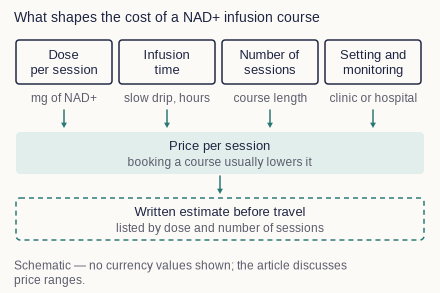
Dosage
NAD+ dosage varies significantly based on the indication:
- General wellness and anti-aging: 250–500 mg per session
- Chronic fatigue and post-COVID: 500–750 mg per session
- Neurological conditions and addiction recovery: 750–1,500 mg per session
Higher doses require longer infusion times (4–8 hours for high-dose protocols) and use more NAD+ compound, both of which affect pricing.
Infusion duration and monitoring
NAD+ must be infused slowly to minimize side effects such as nausea, chest tightness, and abdominal discomfort. A 500 mg infusion typically takes 2–4 hours. Clinics that rush infusions to see more patients per day may charge less but risk more side effects. Proper monitoring and slower infusion rates, as practiced at St. George Hospital, improve tolerability and therapeutic benefit.
Purity and source
The quality of NAD+ compound varies between suppliers. Pharmaceutical-grade NAD+ from reputable compounding pharmacies costs more than lower-grade alternatives. At St. George Hospital, we use only pharmaceutical-grade NAD+ sourced from certified European suppliers.
Clinical setting
There is a meaningful difference between receiving NAD+ in a medical spa or IV lounge versus a licensed hospital or medical clinic. Hospital-based treatment includes physician assessment, vital sign monitoring, emergency response capability, and the ability to adjust treatment in real time — protections that affect cost but significantly reduce risk.
Number of sessions
Most treatment protocols recommend multiple sessions:
- Acute protocol (Lyme, post-COVID, fatigue): 5–10 sessions over 2–3 weeks
- Maintenance protocol: 1–2 sessions monthly
- Longevity protocol: 4–6 sessions annually
Many clinics offer package pricing for multi-session commitments, which lowers the per-session cost.
This connects to our articles on NAD+ IV therapy benefits and cost and 10-pass ozone therapy cost and benefits.
Insurance coverage for NAD+ IV therapy
United States
NAD+ IV therapy is not covered by most US health insurance plans. It is generally classified as experimental or elective. Some Health Savings Accounts (HSAs) or Flexible Spending Accounts (FSAs) may be used, depending on whether a physician prescribes the treatment for a documented medical condition.
Germany and Europe
In Germany, private health insurance (private Krankenversicherung) may partially reimburse NAD+ therapy when prescribed as part of a medically indicated treatment program — particularly for conditions such as chronic fatigue or post-infection syndromes. Coverage depends on the specific insurance contract. Reimbursement cannot be promised: St. George Hospital provides an itemized invoice and medical report, and US patients can be put in touch with an independent US office that pursues reimbursement after treatment; the hospital is not involved in that process. Patients who want to claim use these documents to support insurance claims where applicable.
The value proposition: Cost versus benefit
When evaluating NAD+ IV therapy cost, it is important to consider the broader picture:
- Opportunity cost of illness — chronic fatigue, cognitive dysfunction, and pain carry enormous costs in lost productivity, quality of life, and ongoing medical expenses
- Comparison to conventional treatments — patients with chronic fatigue or post-COVID syndrome often spend thousands on specialist visits, imaging, and medications that do not address the underlying mitochondrial dysfunction that NAD+ targets
- Preventive value — for longevity medicine applications, NAD+ therapy may reduce the risk or delay the onset of age-related conditions whose treatment costs far exceed the investment in prevention
Dr. Julian Douwes notes that patients who receive NAD+ as part of a comprehensive treatment protocol — rather than as an isolated infusion — consistently report more profound and sustained benefits. The context of treatment matters as much as the therapy itself.
How St. George Hospital approaches NAD+ IV pricing
International patients receive a written estimate for the NAD+ block before travel, listed by dose and number of sessions, as part of the overall program cost. The therapy belongs to our medical detoxification therapies, which international patients combine with their condition program during a stay; practical details are on the information for international patients page.
Frequently asked questions about NAD+ IV therapy cost
Is NAD+ IV therapy worth the cost?
For patients with documented mitochondrial dysfunction, chronic fatigue, or post-infectious syndromes, NAD+ IV therapy can provide significant clinical improvement that justifies the investment — particularly when integrated into a comprehensive treatment program. For general wellness purposes, the cost-benefit calculation is more individual. We recommend a thorough medical evaluation before committing to a treatment course.
Why is NAD+ IV therapy so expensive?
Several factors contribute to the cost: pharmaceutical-grade NAD+ compound is expensive to produce, infusions require 2–8 hours of clinical time with monitoring, and proper administration requires trained medical staff. Additionally, the treatment is not mass-produced or standardized in the way that common IV fluids are. Despite the cost, it remains more affordable than many surgical or pharmaceutical interventions for the conditions it addresses.
Can I take oral NAD+ supplements instead of IV therapy?
Oral NAD+ precursors — particularly NMN (nicotinamide mononucleotide) and NR (nicotinamide riboside) — offer a more affordable maintenance option. However, oral bioavailability is significantly lower than IV delivery. Many clinicians, including Dr. Julian Douwes, recommend an initial course of IV NAD+ therapy to restore depleted levels, followed by oral supplementation for maintenance. For severe deficiency or acute clinical needs, IV remains the preferred route.
How does the cost at St. George Hospital compare to US clinics?
A direct comparison is difficult, because St. George Hospital does not price NAD+ as a standalone infusion. Costs are individual per case: a package price for the program plus individual add-ons, listed in a written estimate before you travel. A deposit is paid in advance, and airport transfers are charged extra. Inside the program, NAD+ is given under hospital supervision and alongside the other therapies in your plan.
Do I need NAD+ IV therapy, or is it just a trend?
NAD+ biology is well-established science — its role in cellular energy production, DNA repair, and aging pathways is documented in thousands of peer-reviewed publications. The clinical application of IV NAD+ therapy is newer, and large-scale randomized controlled trials are still needed. It is neither “just a trend” nor a universal solution. The best approach is to work with a physician who can assess whether NAD+ therapy is clinically indicated for your specific situation.
Get a personalized treatment plan and cost estimate
At St. George Hospital, we believe in transparent communication about both treatment options and costs. Our International Office can provide detailed information about NAD+ IV therapy as part of our treatment programs for Lyme disease, post-COVID, chronic fatigue, and longevity medicine.
Contact us for a personalized consultation:
- Phone: +49 8061 398-0
- Email: info@clinicum-stgeorg.de
- Visit: Contact page
References
- Trammell et al., 2016. PMID 27721479