

Welcome from Abroad
For international patients
Patients from more than 60 countries have been treated here, in English or German. The International Office handles your inquiry, your records, your travel and your follow-up questions after you are home.
International patients
Topics in this area
- Treatment program for international patientsChronic Lyme disease program
Many patients who write to us have been ill for years and have had more than one course of antibiotics.
- Treatment program for international patientsLong COVID and ME/CFS program
Many patients with Long COVID or ME/CFS have normal results in standard tests and still cannot manage daily life.
- Treatment program for international patientsIntegrative oncology program
St. George Hospital in Bad Aibling, Germany, has practiced integrative oncology since 1991.
- Treatment program for international patientsWhole-body hyperthermia program
Whole-body hyperthermia raises the core body temperature under controlled medical conditions.
- Planning your stayCosts and insurance
Costs depend on your case: a package price plus the add-ons your plan needs.
- Planning your stayYour first visit
What happens between your first message and the flight home.
- Planning your stayWhy Germany
What the German system lets a licensed hospital do for a patient with a complex chronic disease, which programs international patients come for, and how the trip to …
From Munich Airport to Bad Aibling
- A8 motorway
- Railway
- Airport connection
Regional schematic, not to scale. The airport connection and railway are simplified.
- Fly to Munich (MUC) Munich Airport is about 60 minutes from Bad Aibling by car. Salzburg Airport (SZG) also works.
- By car, with a transfer on request The International Office can arrange the transfer from the airport. Transfers are charged extra.
- Or by train Regional trains run from Munich Hauptbahnhof to Bad Aibling; the hospital is a short taxi ride from the station.
- Planned admission You arrive on the date the International Office has booked. There is no walk-in admission.

Rosenheimer Str. 6-8
83043 Bad Aibling, Germany
How it works, from your first message to aftercare
The International Office handles your inquiry, records, travel and follow-up questions.
Step 1: Initial inquiry
A short message by online form, email or phone. The initial inquiry is free of charge.
Free of charge
Step 2: Reply from the International Office
The International Office reviews your message and your case directly and gets back to you.
Step 3: Secure transfer of records
After the first contact, the International Office requests your medical records and tells you how to send them securely.
Step 4: Medical review and video call
Your records are reviewed medically. A video call with a medically trained member of the International Office is free of charge; a video consultation with a physician is usually charged, and the International Office explains the fee before booking.
Video call with the International Office: free of charge
Step 5: Treatment proposal and cost overview
You receive an individual treatment proposal and an itemized cost overview in writing.
Step 6: Travel, stay and aftercare
The International Office helps you plan travel and your stay. You go home with detailed written plans for your doctor; follow-up questions go to the International Office.
Bad Aibling and the hospital

Bad Aibling and the Mangfall mountains · Flodur63 / Wikimedia Commons, CC BY-SA 4.0 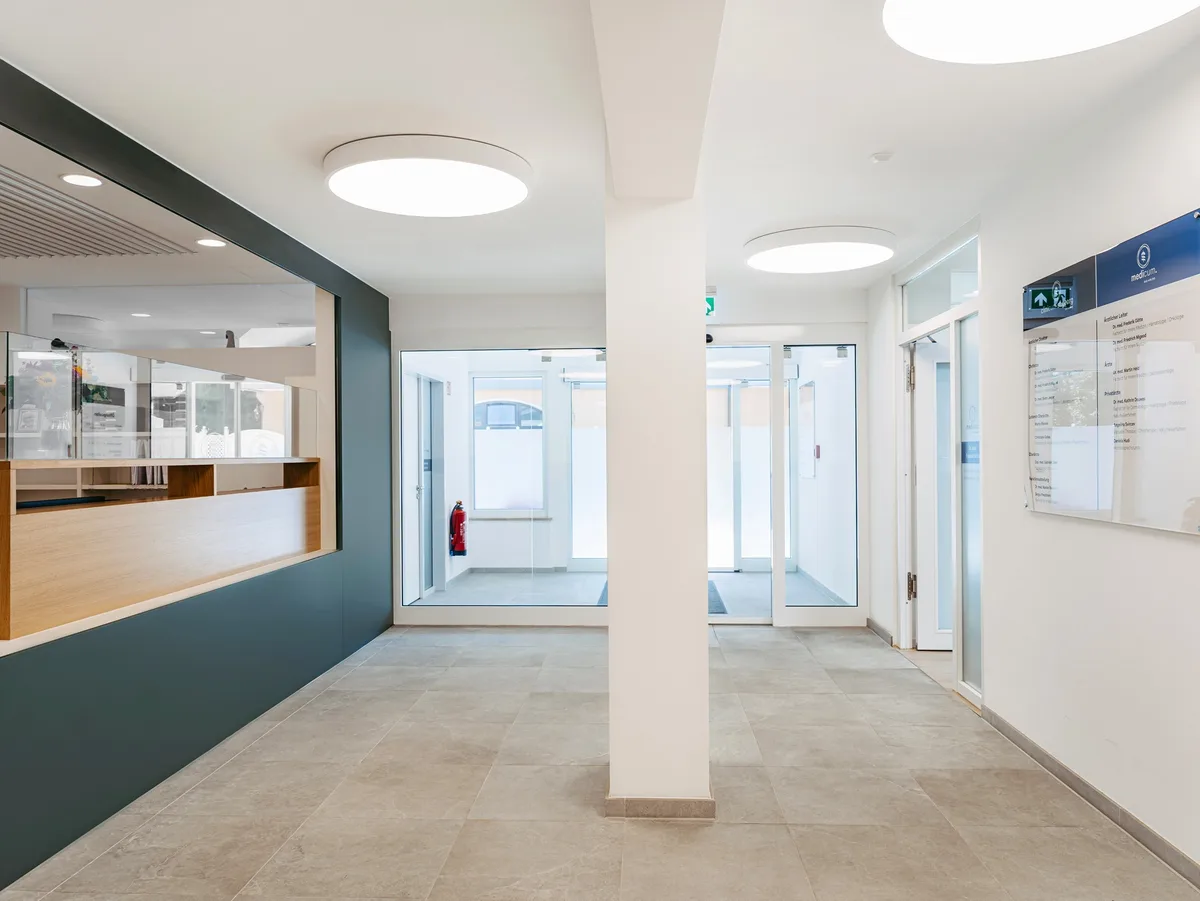
Reception · St. George Hospital 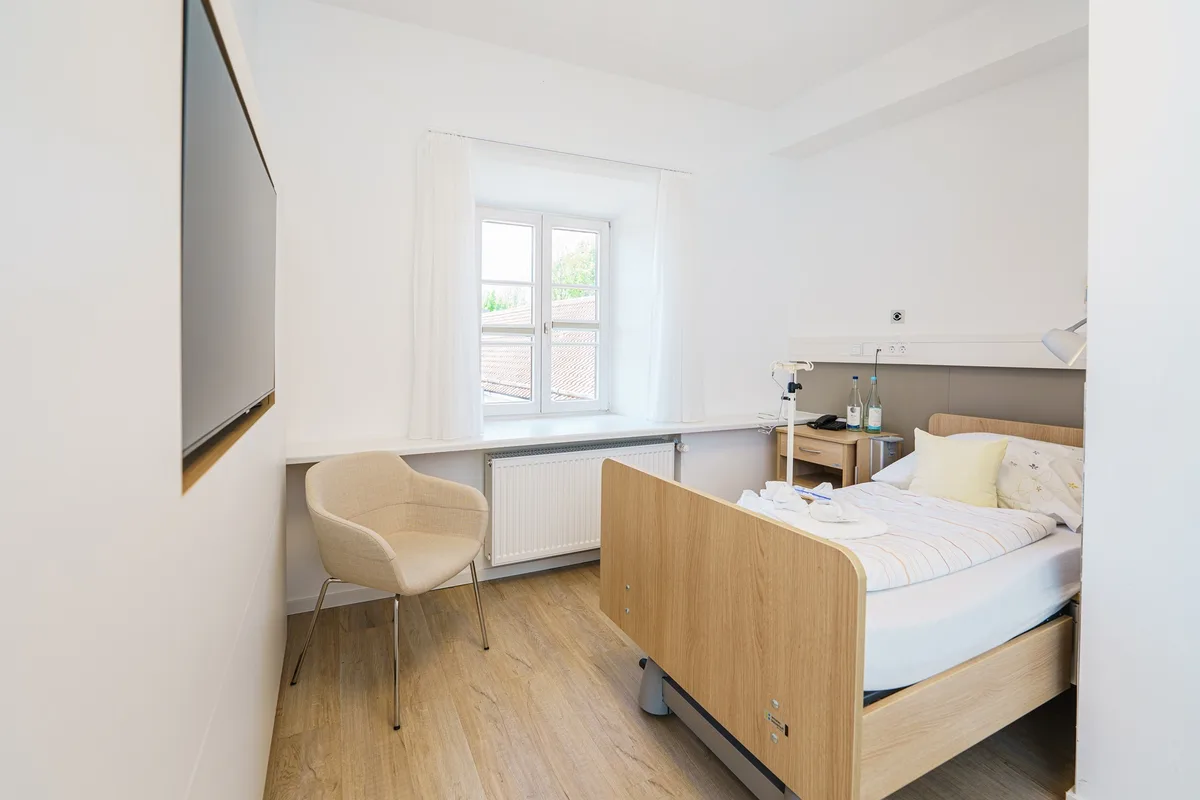
Patient room · St. George Hospital 
Pond in the spa park · Rufus46 / Wikimedia Commons, CC BY-SA 3.0 
Dining hall · St. George Hospital
The hospital is in Bad Aibling, a spa town in Upper Bavaria between Munich and the Alps.
Your contact: the International Office
The International Office answers in English or German. It writes the invitation letter for a medical visa and helps with the airport transfer (charged extra) and a companion's accommodation.
The International Office is reachable Monday to Thursday 08:00 to 17:00 and Friday 08:00 to 14:00 German time (CET/CEST). In the US that is Monday to Thursday 2 to 11 a.m. ET (11 p.m. to 8 a.m. PT, from the evening before) and Friday 2 to 8 a.m. ET (11 p.m. to 5 a.m. PT). Europe and the US change their clocks on different dates, so for a few weeks in March and from late October to early November the US times are one hour later. The video call itself is scheduled at a time that works in your time zone.
Visas
Citizens of the United States, the United Kingdom, Canada, Australia and many other countries enter Germany for up to 90 days without a visa. Where a visa is required, the hospital issues the invitation letter.
Show visa details
If you need a medical visa for Germany, the hospital issues the invitation letter and the treatment confirmation your consulate asks for, in time for your appointment. Check your own country's rules early. Bring a valid passport, the visa if one is required, and your travel insurance documents.
Costs and payment
Self-pay: a package price plus the add-ons your plan needs, and a deposit before admission. Airport transfers are charged extra. Reimbursement is never promised.
Show payment and insurance details
Before you commit to travel, you receive a written treatment proposal and an itemized cost overview. Invoices are in EUR. The itemized invoice lists diagnoses and procedures in English, so you can submit it to your insurer. US patients can be put in touch with an independent US office that works on a success basis and tries to recover costs from insurers after treatment; St. George Hospital is not involved in that process. Costs and insurance
What to prepare before your visit
Bring the originals of your records and the documents on this list. Before admission you fill in an intake questionnaire.
Show the checklist
- Complete medical history summary
- Recent laboratory results and imaging (CDs/digital files)
- Current medication list with dosages
- Pathology reports (if applicable)
- Previous treatment records and physician letters
- Valid passport and visa (if required)
- Travel insurance documentation
Before admission you also complete an intake questionnaire about your history, symptoms and medication, so the first morning on the ward can start with the examination.
Questions patients from abroad ask first
Do I need to travel before I know whether the program is right for me?
No. After your first message the International Office requests your records, they are reviewed medically, and there is a video call before anyone books travel. If a stay does not make sense for you, you are told so at that point. If it does, you receive an individual treatment proposal and an itemized cost overview in writing, and only then do you decide about travel.
Do I send my records with my first message?
No. A short description is enough for the first message: your situation, the diagnosis if there is one, your country and how you would like to be contacted. The International Office then requests your records (recent laboratory results, imaging with the written reports, pathology where it exists, a list of current medication with doses, letters from the physicians who have treated you) and tells you how to send them securely. Incomplete records are fine for the first review.
Do I need a medical visa for Germany?
Citizens of the United States, the United Kingdom, Canada, Australia and many other countries enter Germany for up to 90 days without a visa. Where a visa is required, the hospital issues the invitation letter and treatment confirmation your consulate asks for. Check your own country's rules early, because appointment dates matter.
Can someone come with me?
Yes. A companion can stay on an extra bed in your room where one is available, or in a hotel or guesthouse a short walk from the hospital. The International Office helps with either. Companions are welcome on the ward while you are in a session or resting.
How is the stay paid, and will my insurer reimburse it?
Treatment is self-pay and invoiced in EUR, with a deposit before admission. Costs are a package price plus the individual add-ons your plan needs. You receive an itemized invoice with diagnoses and procedure descriptions in English, which you can submit to your insurer. Reimbursement is never promised. US patients can be put in touch with an independent US office that works on a success basis and tries to recover costs from insurers after treatment; St. George Hospital is not involved in that process.
What happens after I go home?
You leave with detailed written plans, a treatment summary and a follow-up plan, for your physician at home. Follow-up questions, from you or from your physician, go to the International Office.
Send a free inquiry
The initial inquiry is free of charge. The International Office reviews your message and your case directly and gets back to you.
- Phone
- +49 8061 398-0
- Hours
- Mon–Thu 08:00–17:00, Fri 08:00–14:00 German time (CET/CEST); in the US Mon–Thu 2–11 a.m. ET, Fri 2–8 a.m. ET.
Munich Airport (MUC), about 60 minutes by car.