Lugol’s solution, a mix of elemental iodine and potassium iodide, is one of the most useful and affordable preparations in integrative medicine. At St. George Hospital in Bad Aibling, Germany, we have used iodine as a treatment for decades.
What is Lugol’s solution?
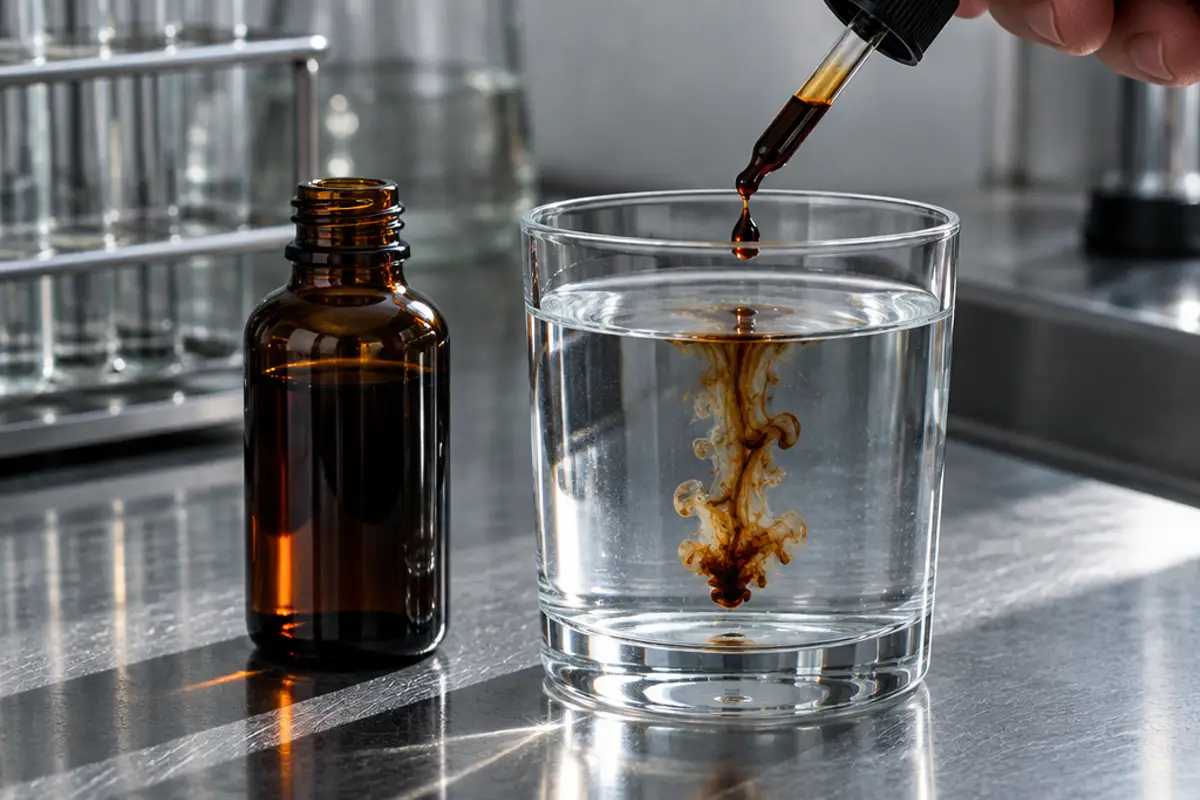
Lugol’s solution is an aqueous solution containing 5% elementary iodine and 10% potassium iodide, in a ratio of 1:2. The formula was developed by French physician Jean Guillaume Auguste Lugol in 1829 and has remained in continuous clinical use for nearly 200 years.
Other names include Lugol’s iodine, iodine-potassium iodide solution (IKI), and Solutio Lugoli.
Each drop of standard 5% Lugol’s solution contains approximately 6.25 mg of total iodine (2.5 mg iodine + 3.75 mg potassium iodide). A 2% formulation provides approximately 2.5 mg per drop.
See also our article on functional medicine testing.
Lugol’s solution dosage chart
The dose depends on why iodine is given. The chart shows reference ranges from the published literature. Always consult a physician before supplementing with iodine.
| Indication | Lugol’s 5% Dosage | Total Iodine | Frequency |
|---|---|---|---|
| General maintenance | 1–2 drops | 6.25–12.5 mg | 2–3 times per week |
| Iodine deficiency correction | 2–4 drops | 12.5–25 mg | Daily for 2–3 months |
| Thyroid support (hypothyroid) | 1–2 drops | 6.25–12.5 mg | Daily, physician-monitored |
| Pre-operative thyroid prep | 3–5 drops | 18.75–31.25 mg | 3x daily for 10 days |
| Immune support (during illness) | 1–2 drops | 6.25–12.5 mg | 3 times per week |
| Integrative oncology support | 1–4 drops | 6.25–25 mg | Daily, physician-supervised |
| Radiation protection (nuclear emergency) | Per public health directive | 130 mg KI | Single dose |
Note: Some integrative physicians such as Dr. Brownstein have used higher therapeutic doses (50–200 mg/day) under close medical supervision. High-dose iodine therapy should only be undertaken with physician guidance and appropriate monitoring.
How many drops of Lugol’s iodine per day?
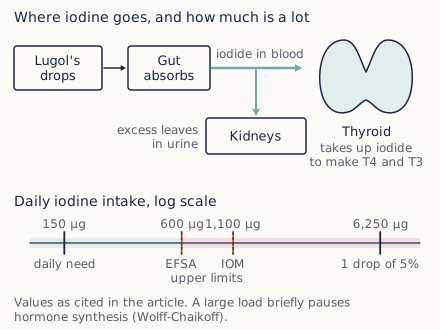
For most adults the answer is fewer than the internet suggests. One drop of 5% Lugol’s delivers about 6.25 mg of iodine, which is roughly forty times the adult daily requirement of 150 µg and above the tolerable upper intake level of 1,100 µg per day set by the US Institute of Medicine (600 µg in the EFSA guidance). That is why the maintenance row in the chart reads two to three times a week rather than daily, and why daily dosing belongs under physician monitoring with a thyroid panel. Healthy thyroids tolerate short periods of high iodine intake through an autoregulatory mechanism first described in rats in 1948, the Wolff-Chaikoff effect, in which a large iodide load transiently blocks hormone synthesis in the gland (Wolff and Chaikoff, Endocrinology, 1948). People with existing thyroid disease, or who were iodine-deficient before, are the ones in whom an intake only slightly above physiological needs can tip into hyper- or hypothyroidism or thyroid autoimmunity (Farebrother et al., Annals of the New York Academy of Sciences, 2019).
How much iodine is in one drop of Lugol’s 2%?
About 2.5 mg. Lugol’s 2% contains 2 g of elemental iodine and 4 g of potassium iodide per 100 mL; potassium iodide is 76% iodine by weight, so each milliliter carries roughly 50 mg of total iodine and a standard 0.05 mL drop about 2.5 mg. The 5% solution scales accordingly to about 6.25 mg per drop. Drop size varies between dropper bottles, which is one reason the chart gives ranges rather than exact figures.
| Strength | Iodine + potassium iodide per 100 mL | Total iodine per drop | Drops per 1 mg of iodine |
|---|---|---|---|
| Lugol’s 2% | 2 g + 4 g | ≈ 2.5 mg | less than half a drop |
| Lugol’s 5% | 5 g + 10 g | ≈ 6.25 mg | a sixth of a drop |
Lugol’s iodine dosage for hypothyroidism
It depends on why the thyroid is underactive. Where hypothyroidism comes from iodine deficiency, which still affects an estimated two billion people worldwide and is the most common preventable cause of mental impairment, bringing intake back to the requirement is the treatment, and iodized salt or low-dose supplements do that (Zimmermann et al., Lancet, 2008). Where hypothyroidism is autoimmune (Hashimoto’s thyroiditis), the picture reverses: people with pre-existing thyroid disease are the group most likely to react badly to iodine above physiological needs (Farebrother et al., 2019). In that situation iodine is not given from a chart. TSH, free T4, thyroid peroxidase antibodies, selenium status and a urinary iodine value are measured first, and any iodine is dosed low and re-checked.
We go into this further in our article on the selenium and thyroid connection.
How to take Lugol’s iodine
Lugol’s solution has a strong taste. These steps make it easier to take:
- In water or juice: Add drops to a glass of water or orange juice. The vitamin C in juice may reduce the iodine taste.
- With food: Take with or immediately after a meal to reduce gastric irritation.
- Start low: Begin with 1 drop and gradually increase over days to weeks, especially if you have not supplemented iodine previously.
- Companion nutrients: Many practitioners recommend taking selenium (200 mcg), vitamin C (1,000 mg), and magnesium alongside iodine supplementation to support thyroid function and detoxification pathways.
- Consistency: Take at the same time each day for steady levels.
Important: Do not paint Lugol’s solution on the skin as a way to supplement. Absorption is unpredictable, and it stains.
There is a separate article on magnesium deficiency symptoms.
Medical uses of Lugol’s iodine
Iodine is an essential trace element, and its roles reach beyond the thyroid:
Thyroid hormone production
Iodine is the main building block of the thyroid hormones thyroxine (T4) and triiodothyronine (T3), which regulate metabolism, energy production and development. Deficiency leads to hypothyroidism, goiter, and in severe cases, cognitive impairment.
Preoperative preparation in Graves’ disease
This is the best-documented medical use of Lugol’s solution outside deficiency. Given for about ten days before thyroidectomy, it reduces blood flow in the gland. A 2019 systematic review and meta-analysis of nine comparative studies (510 patients) found less thyroid vascularity and less intraoperative blood loss with preoperative iodine, and no difference in postoperative complications (Tsai et al., Otolaryngology–Head and Neck Surgery, 2019).
Antiseptic use
Iodine is an established topical antiseptic. Claims that circulating iodine “purifies” the blood as it passes through the thyroid are not supported by the literature, and we no longer make them; the immune relevance of iodine in the body runs through adequate thyroid hormone, not through a filtering effect.
Halogens and heavy metals
Bromide and fluoride compete with iodide at the thyroid’s transport system, which is the mechanism behind the advice to keep iodine intake adequate when exposure to these halogens is high. Whether iodine supplementation increases the excretion of heavy metals such as mercury or lead has not been shown in controlled studies; chelation, where indicated, is a separate and tested procedure.
Breast health
Breast tissue concentrates iodine at levels second only to the thyroid. Research has associated iodine deficiency with increased risk of fibrocystic breast disease and breast cancer. Iodine supplementation has been shown to reduce fibrocystic changes in clinical studies.
Cell growth regulation
Iodine influences apoptosis (programmed cell death) and helps regulate excessive cell growth in tissues including thyroid, breast, prostate, and ovarian tissue.
Natural sources of iodine
Dietary sources of iodine include:
- Seaweed and kelp (highest concentration)
- Ocean fish, haddock, cod
- Shellfish and oysters
- Unrefined sea salt
- Eggs and dairy products
- Dark green vegetables, asparagus, artichokes
Dietary intake is not always sufficient. Diets low in seafood and dairy, unrefined salt without iodization, and high bromide or fluoride exposure all push intake down. The population measure for this is the median urinary iodine concentration, which is also the test we use for individuals (Zimmermann et al., 2008).
Lugol’s iodine side effects
When used at appropriate doses, side effects are uncommon. Potential effects include:
- Metallic taste: common and usually temporary
- Stomach irritation: less likely when taken with food
- Thyroid sensitivity: people with Hashimoto’s thyroiditis or Graves’ disease should use iodine only under medical supervision
- Iodine allergy: true iodine allergy is rare; most “iodine allergies” are reactions to contrast media or shellfish proteins
- Detoxification symptoms: bromide and fluoride displacement can cause a temporary headache, skin changes or a metallic taste (the “bromide detox” effect)
Contraindications: Hyperthyroidism, untreated Graves’ disease, iodine hypersensitivity. Always consult a physician before starting iodine supplementation, particularly if you have thyroid disease or are taking thyroid medication.
How St. George Hospital approaches iodine
Iodine is prescribed here from the thyroid panel and a urinary iodine value, with selenium status checked first; the dose is adjusted at follow-up rather than fixed. This is part of functional medicine in a hospital setting; the admission process for patients from abroad is described under information for international patients.
Iodine status is part of our functional diagnostics panel. Our physicians use iodine in treatment plans for:
- Thyroid optimization
- Immune support during integrative treatment programs
- Detoxification protocols for heavy metals and environmental toxins
- Integrative oncology, as a supportive element alongside the main therapies
Each patient gets a dose and a date to re-check it.
What this means for you
- If you are healthy and eat seafood, dairy or iodized salt, you probably do not need Lugol’s at all; the requirement is 150 µg a day and one drop is forty times that.
- If you have a diagnosed thyroid condition, test before you dose: TSH, free T4, thyroid antibodies, selenium and a urinary iodine value.
- If you decide to supplement, start with the maintenance row of the chart, take it with food, and stop and call a physician if you develop palpitations, heat intolerance or a tender thyroid.
- Keep a bottle away from children: a few milliliters contain a dose that is unsafe for a small child.
Frequently asked questions
Is Lugol’s solution the same as povidone-iodine?
No. Povidone-iodine is a topical antiseptic in which iodine is bound to a polymer; it is not meant to be swallowed. Lugol’s is an aqueous iodine and potassium iodide solution used orally in the doses described above and in pharmacies for specific indications.
Can I take Lugol’s iodine with Hashimoto’s thyroiditis?
Only under medical supervision and after testing. People with pre-existing thyroid disease are the group most likely to develop hypothyroidism, hyperthyroidism or rising antibodies when iodine intake goes above physiological needs (Farebrother et al., 2019).
How is iodine status tested?
By a urinary iodine concentration, which reflects recent intake, together with TSH, free T4 and thyroglobulin where needed. A single urine sample is a screening value; repeated samples give a more reliable individual estimate (Zimmermann et al., 2008).
What are the signs of too much iodine?
A metallic taste, a runny nose, acne-like skin changes and a tender or swollen thyroid, and in some people the symptoms of an over- or underactive thyroid. Stop the supplement and have the thyroid panel checked.
Contact us
Questions about iodine testing or treatment at St. George Hospital go to the International Office; the initial inquiry is free of charge.
Phone: +49 8061 398-0
Email: info@clinicum-stgeorg.de
Address: Rosenheimer Str. 6-8, 83043 Bad Aibling, Germany
This article is for educational purposes. Iodine supplementation should be guided by a qualified healthcare provider based on individual assessment.
References
- Wolff and Chaikoff, Endocrinology, 1948. PMID 18884583
- Farebrother et al., Annals of the New York Academy of Sciences, 2019. PMID 30891786
- Zimmermann et al., Lancet, 2008. PMID 18676011
- Tsai et al., Otolaryngology–Head and Neck Surgery, 2019. PMID 30721111